FOOTPATHS is a solo entry for the 2026 Epic AI MegaJam, built in Unreal Engine 5.8. Animals leave glowing trails. The player nudges the world to change where they go, then cuts a piece of their journey and walks on it. AI agents wrote the code and drove the editor. This log records what was built, what was cut and what failed.
Solo entry
Unreal Engine 5.8
Deadline Mon 16 Nov, 02:59 CET
Sat 14 Nov
Sat 14 Nov · 15:45 CET
Project selection
Today we started with 35 hours left. We read the jam rules and all 89 existing entries. Most entries read the theme literally: film sets, takes, editors. We chose FOOTPATHS, an idea from an earlier notebook that had not been built. Two independent rankings of the shortlist both placed it first. That is a judgment with a second opinion behind it, not proof. If movement does not feel right by 22:00, the fallback is ONE SHOT.
Work
Agents read the jam entries and ranked the shortlist twice, the second time blind.
Sat 14 Nov · 16:30 CET
Brief, skills and ground rules
Before opening the engine we wrote the project brief, a level design guide and the art direction. Agents write the C++ and drive the editor; the game is played and judged by hand. We reused skills from earlier projects: a director skill for writing briefs, a referee that scores work independently, and a creature motion skill. Two rules were set: feel first, then content, then polish; and shortcuts are acceptable for parts but never for the rules of the puzzle.
Work
Agents adapted the skills and wrote the level design guide and art direction.
Sat 14 Nov · 16:40 CET
Research prepass
Four agents built a knowledge base: Unreal 5.8 systems, look and performance, design references and asset sources. The jam rules were checked at the source (the itch.io page and Epic's announcement). Each entry can win one main prize and one modifier. The deadline is Mon 16 Nov, 02:59 CET. The project moved into git so the history stays accurate, and decisions D-006 to D-011 were logged.
Work
Four research agents, one per topic.
Cut
Free scrubbing as the default control (D-008). DLSS 4.5 only if time allows, limited to 45 minutes (D-009).
Sat 14 Nov, later
Sat 14 Nov · 17:00 CET
First playable build
The first packaged Windows build ran and loaded Room 1 at 16:59, two and a half hours before the 19:30 checkpoint. It contains walk speed and jump forgiveness, the moth's glowing trail with rest pads, the moth's loop, Cut mode with slow motion, a letterbox and snapping IN and OUT points, and the walkway that sweeps in. The cut rules pass nine automated checks. The feel test had not been done yet, and it decides whether the movement stays.
Three problems appeared and were fixed. The packaging script did not expand a PowerShell variable. The cook failed once on a missing config entry. The glow material lacked the flag that makes trails show in a shipped build, which only the packaged build revealed.
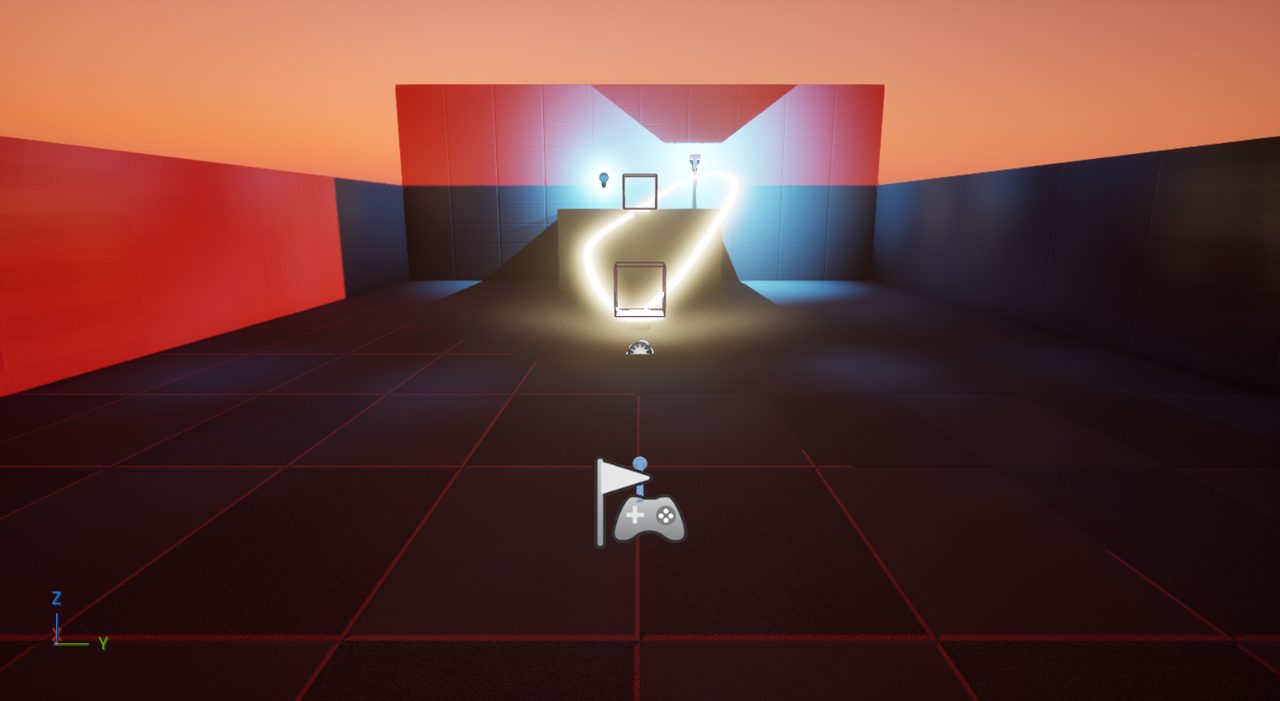
Room 1 greybox in the editor. The loop runs from the flowerpot up to the balcony. Blockout only; the sky reads as sunset for now.
Work
The main session wrote the C++ core, the level script and packaging. A Sonnet agent built six reference boards (77 images) for look work.
Cut
Blockout body is a cylinder (D-012). HUD is canvas, not final UI. Trail is a mesh strip, not Niagara (D-012). Sky reads as sunset, not dusk (D-013).
Sat 14 Nov · 17:15 CET
First playtest, and the cut changes
Playtest findings: scrolling jumped from one edge to the other, the timeline needed to feel smooth and weighted, and fully predefined cuts removed the puzzle. The player also got stuck and had no way to clear a trail.
We changed the design rather than the numbers. Snapping to rests was removed. The playhead is now a glowing bead on a soft spring and pulls onto a rest only when paused near one. IN and OUT can go anywhere, so choosing the cut is the puzzle. Reaching the 12 m Span locks the playhead. Double-click clears the marks. Each change was rebuilt and replayed within minutes.
Work
The main session made every change. Design calls came from the playtests.
Cut
Snapping to rests (D-014 to D-017). Walkway side rails, which could spawn inside the player. Deck pieces that would trap the player now wait until it is clear.
Sat 14 Nov · 17:45 CET
The whole game in grey box
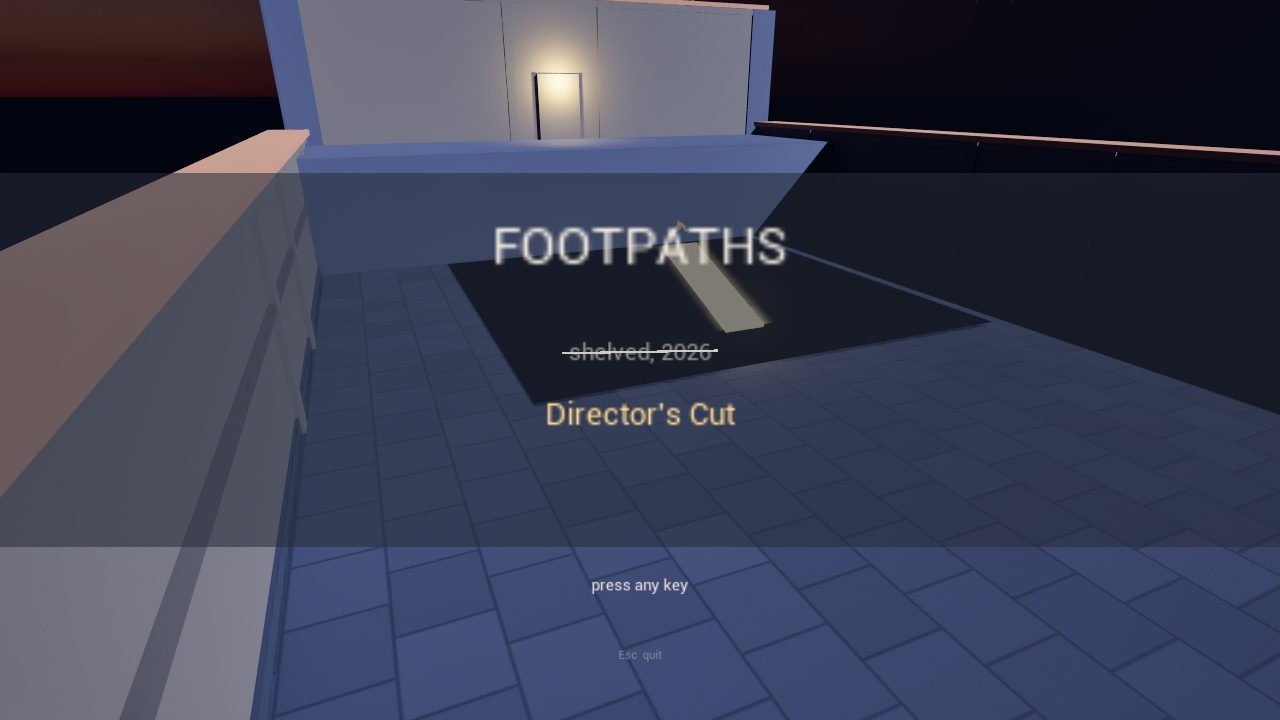
The rest of the game went from nothing to grey box. The flow is a title card that crosses out "shelved, 2026" and writes "Director's Cut", then the rooms, then "That's a wrap." A nudge system lets E tilt the lamp or move the bowl. A cat walks. Rooms 2, 3, 4 and 6 exist as grey boxes, all built by one script that can be re-run. Every map loads in the packaged build with zero errors.
Two problems cost time. The Python script swapped red and blue in the light colours, so lamps came out blue and the moon red. The room script also reported success while silently failing to overwrite existing maps, which was found by checking file timestamps. Both are fixed and the script now fails loudly.
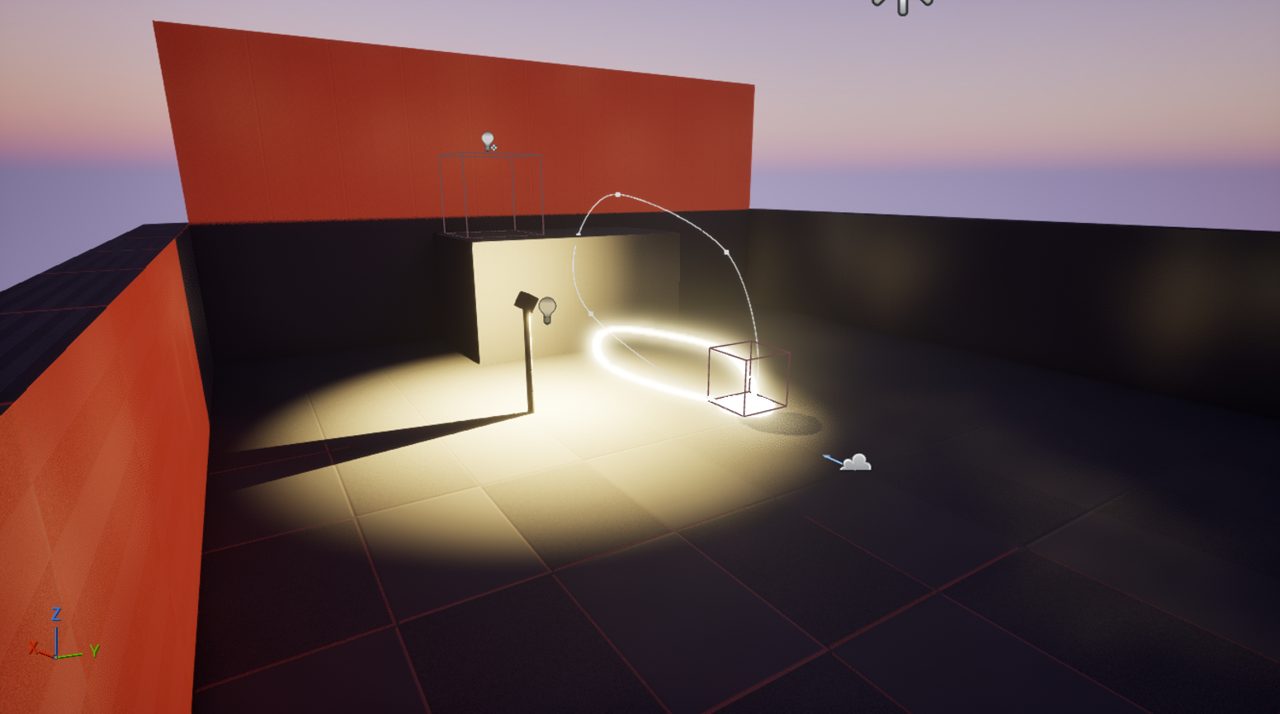
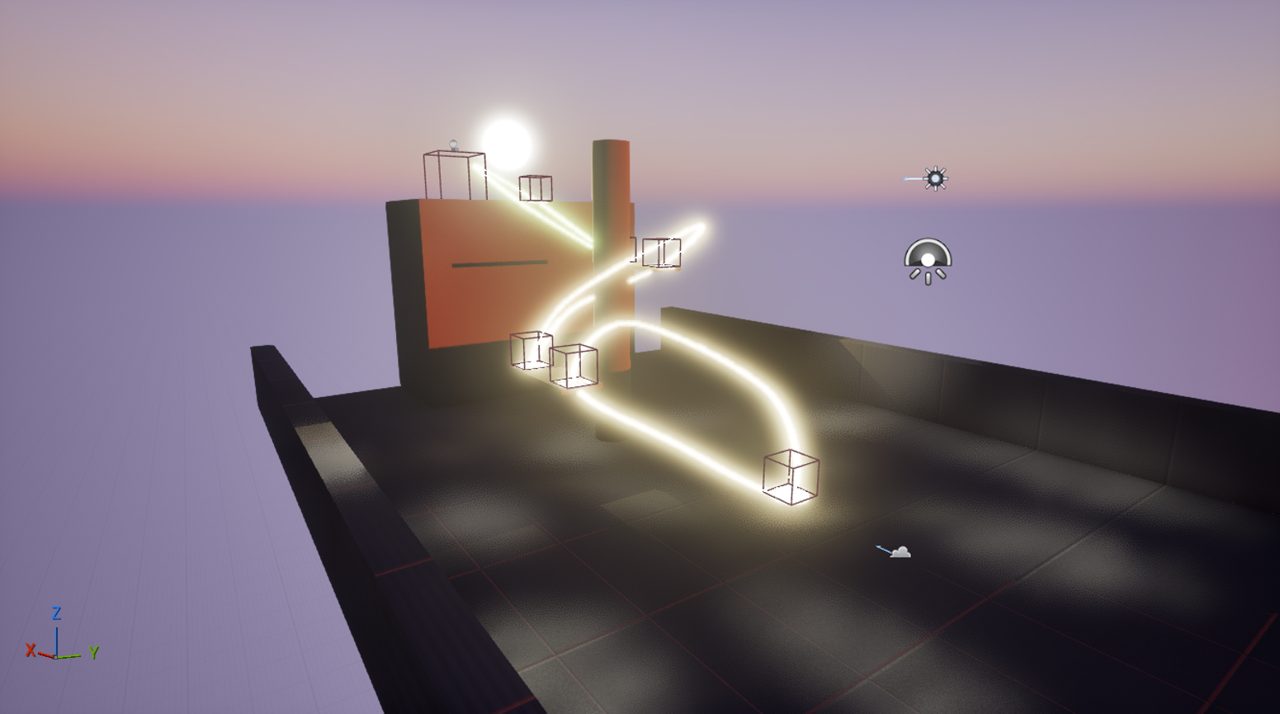
Room 2, Tilt. The lamp and the low moth loop under the ledge.Room 6, The Moon. Three trails climb the tree to the moon.
Work
The main session wrote the code, rooms and packaging.
Cut
Not played yet: rooms 2 to 6, audio and the look. Everything is still grey box.
Sat 14 Nov · 18:45 CET
First look pass: blue hour
The grey box received a dusk look, built into the shared room code so every room inherits it. The sky is blue hour: a sun just below the horizon colours the air and a separate cold moon casts the shadows. Outlines are soft graphite drawn from depth, with gentle posterizing and one colour grade. Walls and floors were darkened so the trails are the brightest thing on screen. Trails are wider and keep their colour, so the gold moth and the cyan cat read as different creatures.
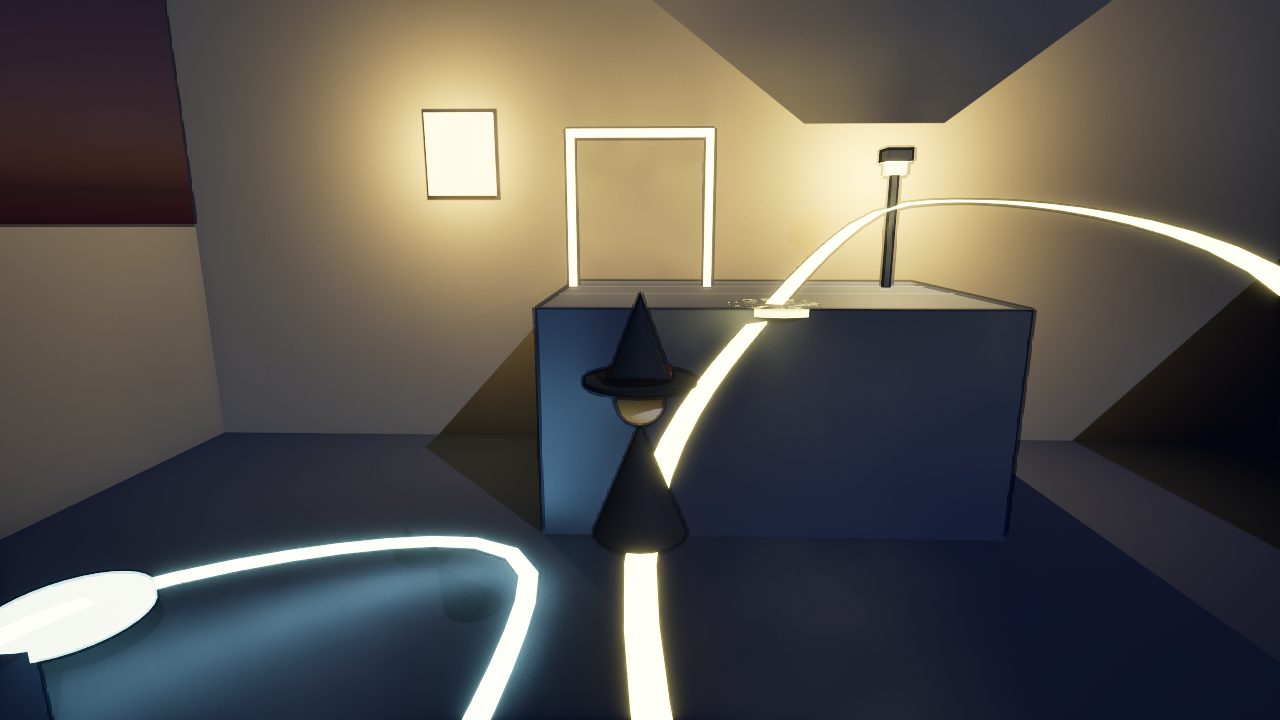
The sky took longest. A rotation argument-order bug in the Python gave every room an orange sunset and a sun disc. Fixing the pitch produced midday, so the light was split into a sun below the horizon and a real moon. The outline looked missing because it was 1 pixel wide after upscaling, which a red-ink test frame confirmed. Exposure had little effect under auto exposure, so the walls were given darker colours instead.
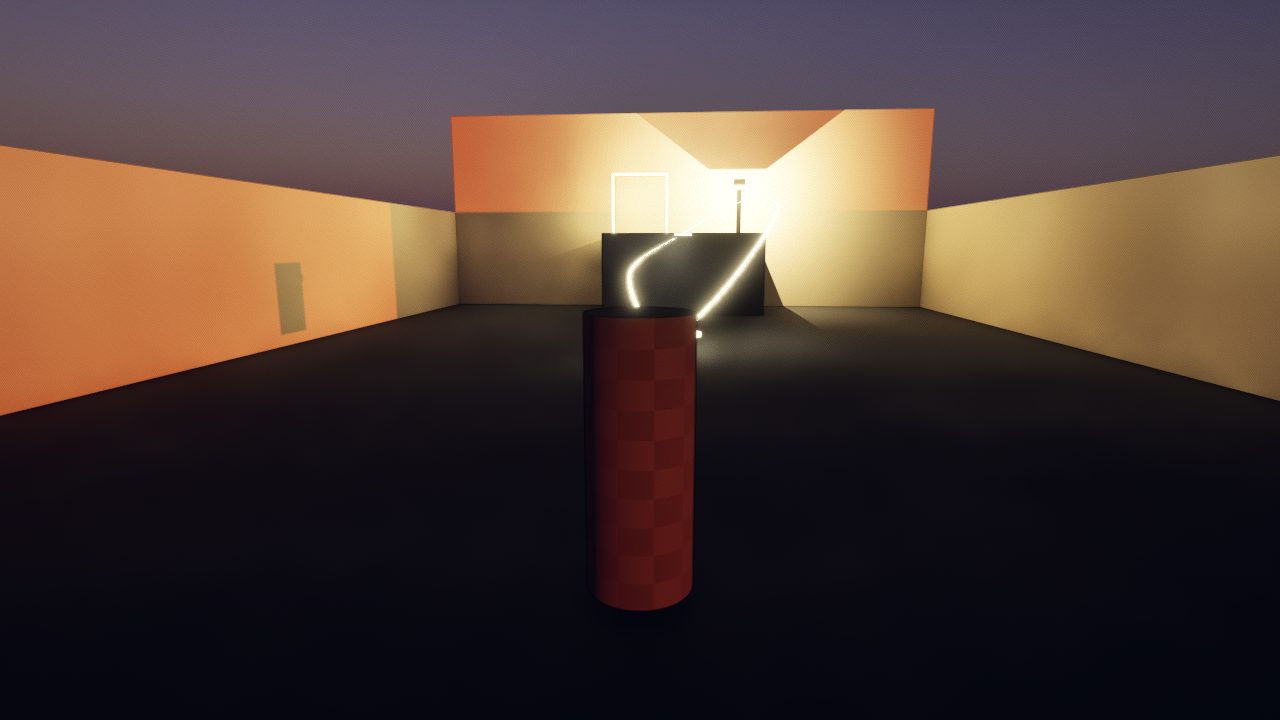
Before the fix. A rotation bug turned the moon into an orange sunset.After. Blue hour, graphite outlines, trails brightest on screen.
Work
A backlog agent session wrote the look code and a capture tool that shoots 720p frames from a hidden offscreen game process. The referee scored from measured pixels: round 1 REWORK (Visuals 2), round 2 in review.
Cut
Room 6 branch fixes, reward perches and the cat route-swap glide, dropped because v2 (D-023) rebuilds the rooms and creatures. Look not yet approved.
Sat 14 Nov · 19:10 CET
Trails rendering white
The trails rendered white. Lowering the glow did nothing, because auto exposure rescaled the whole frame and the tonemapper bleached bright pixels. The dusk lights are dim enough that the scene needs +3.5 stops of exposure, so every glowing object was about ten times too hot. The look now runs at one fixed exposure and every glow was rescaled to match. All glow numbers live in one settings file, so look tuning no longer needs a C++ build.
The first fixed-exposure values still bled to white. The next set kept the hue but looked flat. A middle setting is still being tuned. A decision number was also duplicated: D-026 was taken, so this became D-032. The connect-the-dots marks received an animated link: gold pulses flow toward the target and broken links flicker red.
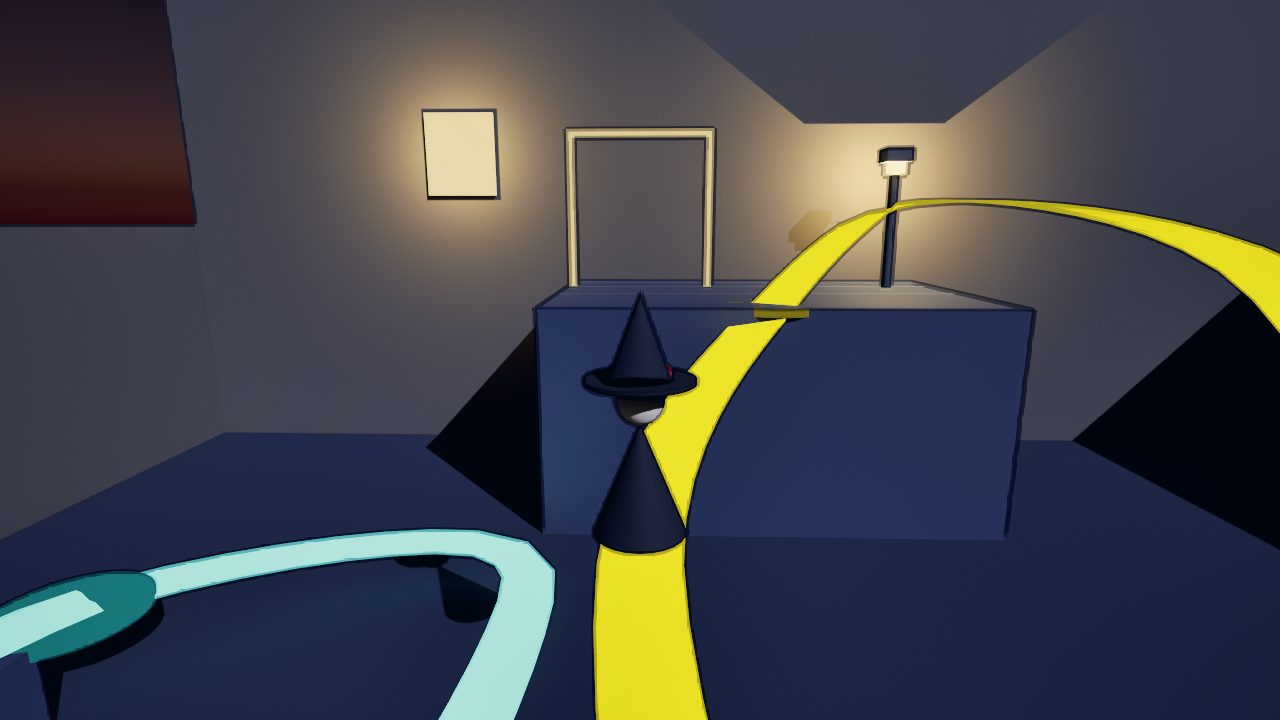
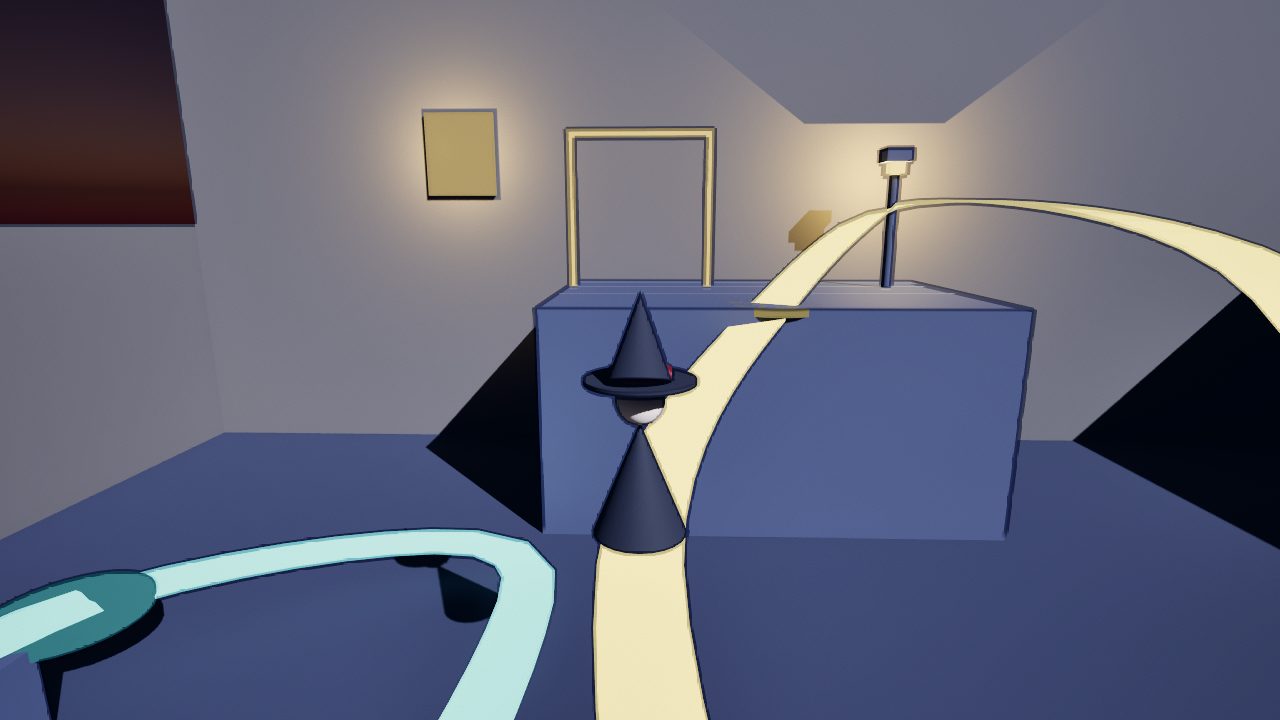
Before. Trails bleach to white under auto exposure.Hue restored but flat. The next pass finds the middle setting.
Work
A backlog agent session ran two automated sweeps of exposure and glow in a hidden offscreen process, measuring pixels with PIL. The referee scored three rounds: Visuals 2, 3, 3. The main session moved the glow numbers into one settings file.
Cut
Auto exposure, replaced by a fixed +3.5 stops (D-032). Look not yet approved. The music-box loop is a synthesized placeholder.
Sat 14 Nov · 19:15 CET
Calmer drawing, and real sounds
Drawing a trail was made calmer. The camera centres on what is being drawn and guide lines show only toward the three spots nearest the cursor. The first version chased its own tail because it aimed from the orbiting, lagging camera. It now aims once per dot from the witch's shoulder. This is not yet confirmed in play.
Seven sounds now come from the Sonniss GDC 2026 library instead of code: the dot snap, the refusal, the walkway shimmer, the rewind whoosh, the lamp switch, the clapper and the night crickets. Footsteps and the arrival sting are still synthesized. Audio had to be in by Sunday 17:00; this is the first real sound in the build.
Work
The main session wrote the camera and swapped the sounds in.
Cut
Footsteps and the arrival sting stay synthesized for now (D-033). The camera fix is not yet approved (D-034).
Sat 14 Nov · 19:40 CET
Referee round: REWORK
The camera still felt off, so we brought in research agents, pilots and a global referee. Three ran in parallel. The referee's verdict was REWORK, and the first finding was that the packaged build shipped the old game. Scores: Theme 4, Ambition 3, Fun 2, Gameplay 2, Visuals 2, Audio 2, Level 1. A code audit found 15 interaction problems and confirmed 12.
Fixed the same hour. The game now runs Title, five new directing rooms (Action, Blocking, Lights, The Cat, Set-up), then the end. All five pass their in-engine path checks. Room 2 failed first, at 34 degrees against a 25 degree limit, and was laid out again. The new camera is a director's frame: it lifts and backs off until the animal, its spots and the witch fit the screen, and it does not move while dragging. An agent drove play mode to check it. Nine interaction fixes went in: opening a timeline no longer wipes the trail underfoot, Z removes one dot, and a direct prompt shows over the animal.
The colours had been typed in the wrong colour space, so the cat trail came out mint-white. The cyan and gold are now correct. The look referee passed round 5. The trails still read as flat tape and the witch is still two cones. Nothing here has been played yet.
The colour fix. True cyan and gold, still pale and flat.
Work
A referee, a camera researcher and a code auditor ran in parallel. Pilot agents drove play mode. The main session built the rooms and fixes.
Cut
Trails still read as flat tape and the witch is still two cones. Nothing approved yet (D-035, D-036).
Sat 14 Nov · 20:00 CET
Look pass approved, first take filmed
The referee passed the look in round 5 with Visuals 3 and no blockers. Trails keep their colour, nothing clips to white, and they are 7.5 to 12 times brighter than the floor. A soft halo strip now glows along every fresh trail. The engine's bloom threshold works before exposure, so trails never bloomed; the halo is a strip wired in by hand.
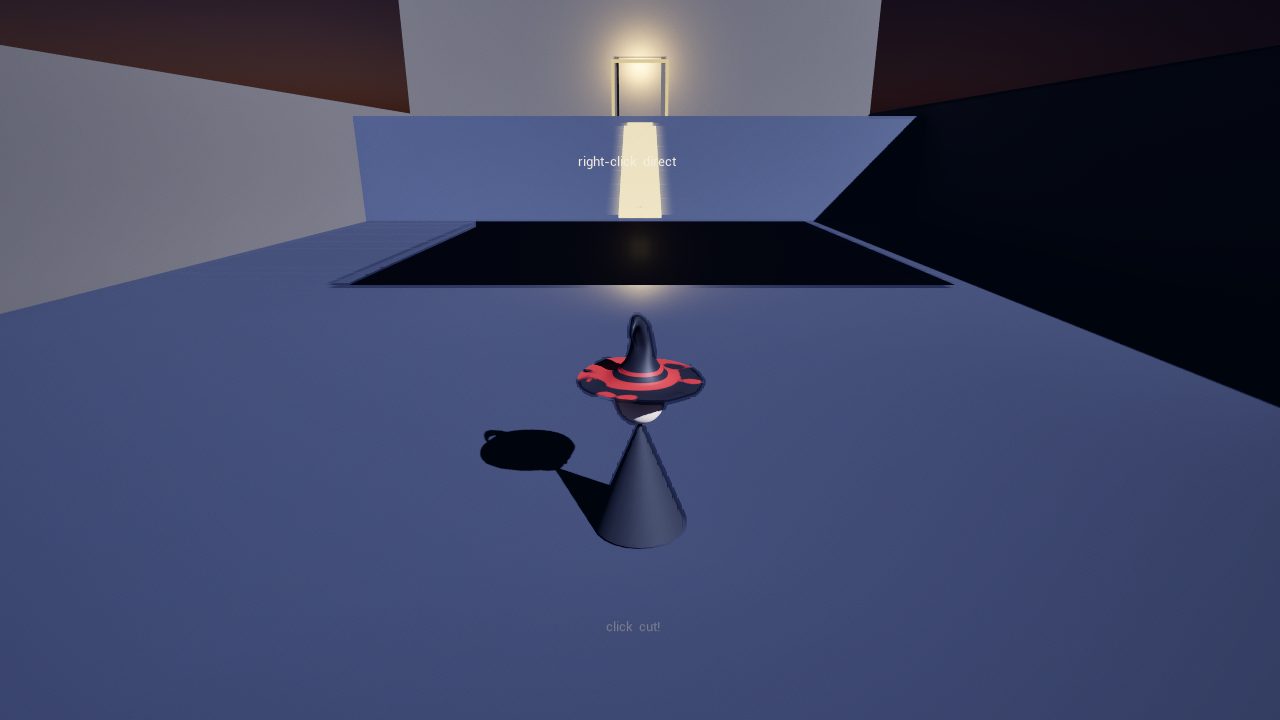
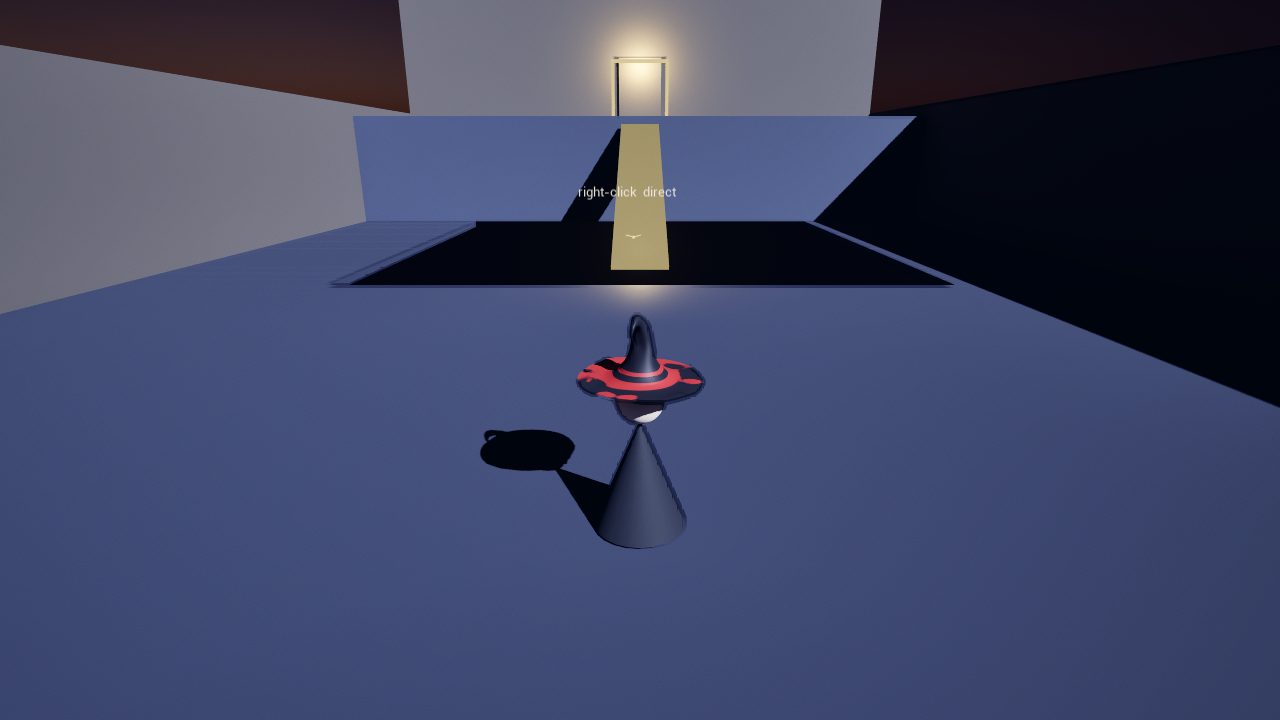
The first take was filmed with no one at the controls. A debug command drove the moth along its route. The fresh trail glowed, then Cut froze it into a solid chalky walkway with its own shadow. The witch's hat is now black with red bands and reads at 720p. An outline fix that had been claimed to work was disproved by the referee, who measured the edge pixels. The cause was a unit error: the outline was scaled about 11 times too small. It is fixed. The halo first glowed too strongly and outshone the trail, so it was lowered to 0.06.
The first take. A fresh trail, with the witch in red-banded black.After Cut. The trail is a solid walkway with its own shadow.
Work
The backlog agent did captures, materials and measurements. The referee gave six rounds of pixel-measured verdicts. The main session wired the halo strip and the debug command, because the editor tools could not drive the game's drag controls.
Cut
UE bloom, replaced by a hand-made halo strip. The zip README and end-card credits are drafts.
Sat 14 Nov · 20:45 CET
Dressing the grey boxes
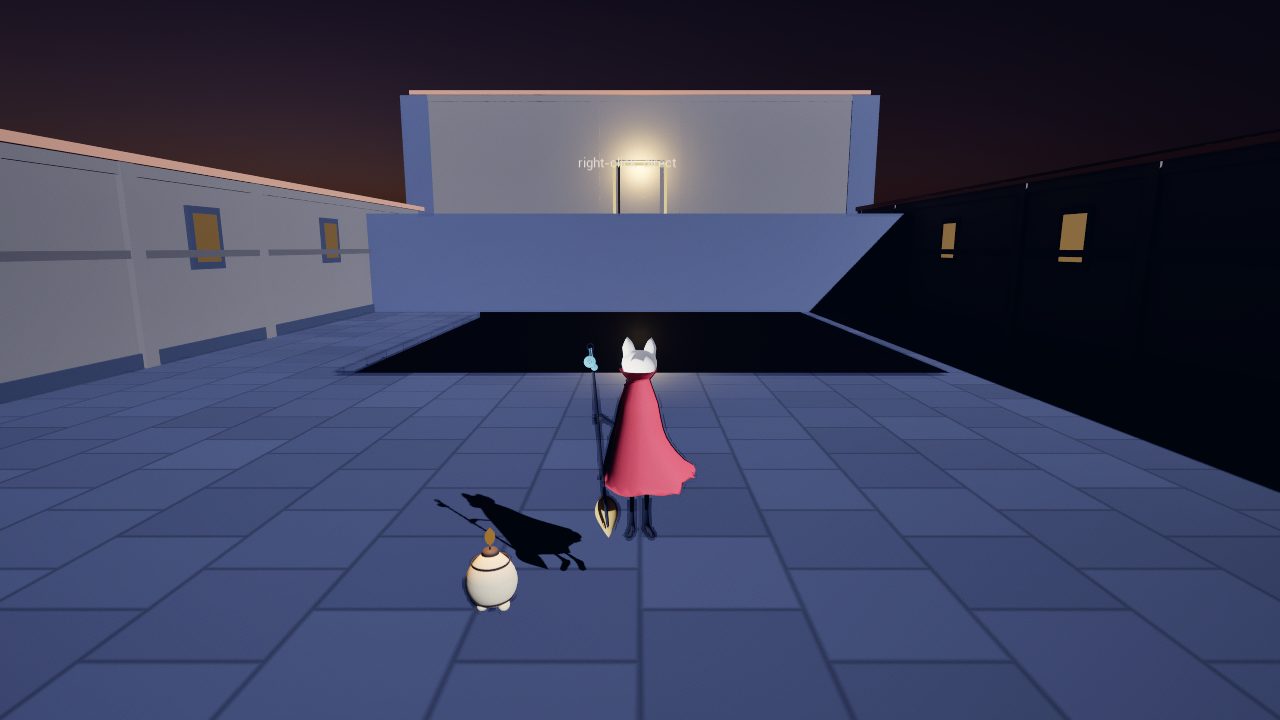
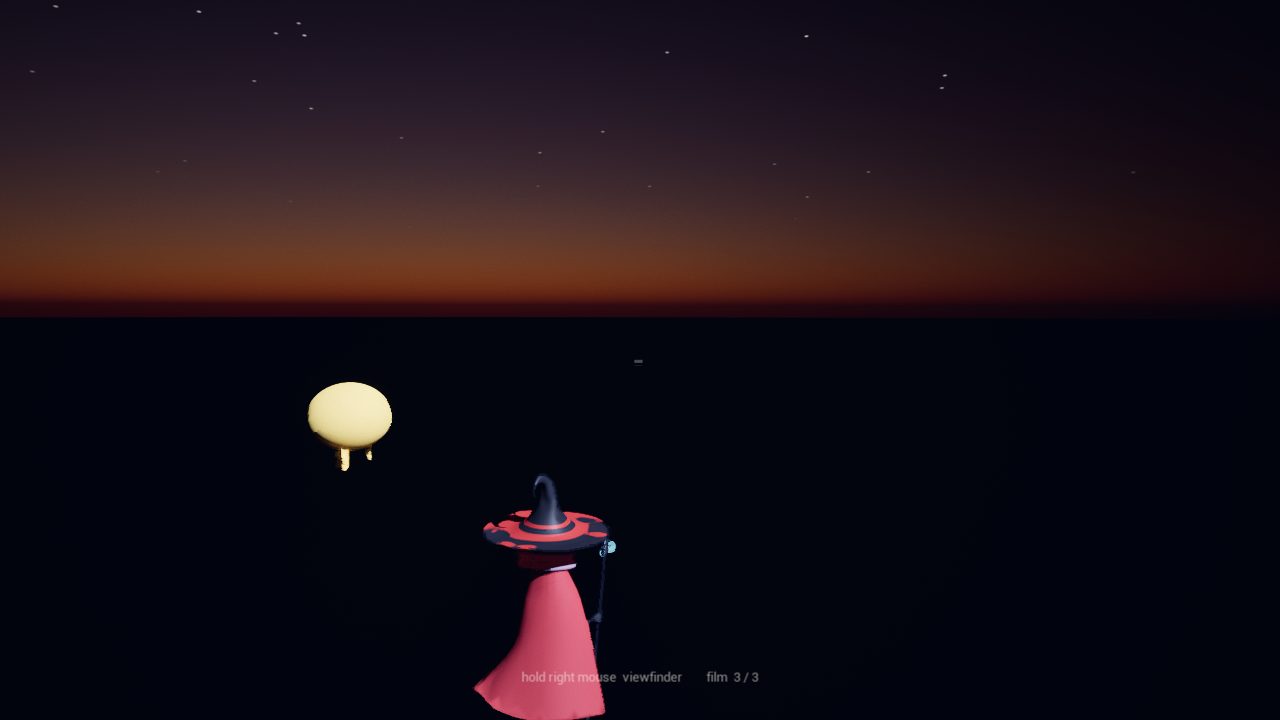
The rooms were still grey boxes, so we dressed them. Everything comes from engine basic shapes and our own materials; no store assets. Walls get roof-tile caps, string courses, pilasters, small amber windows and corner pillars, all generated from each room's own walls. None of it collides and it keeps clear of every puzzle piece. The floor is a flagstone pattern and the sky has sparse stars and a moon disc.
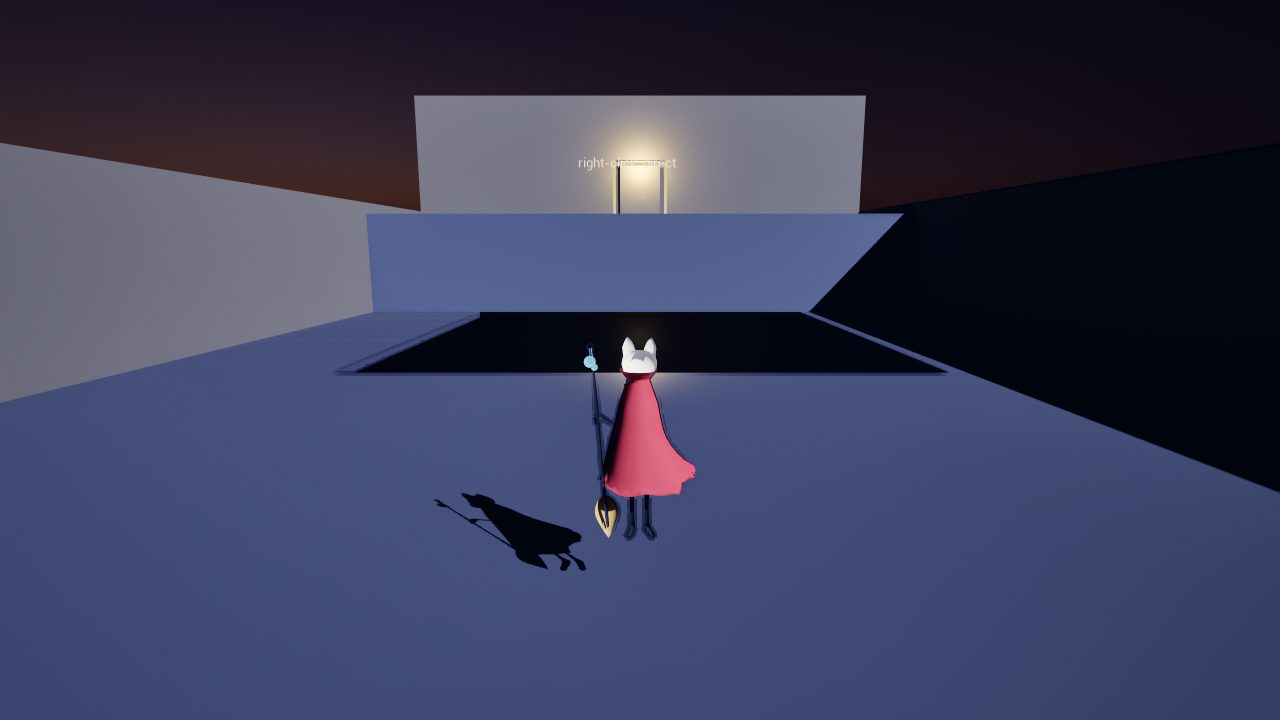
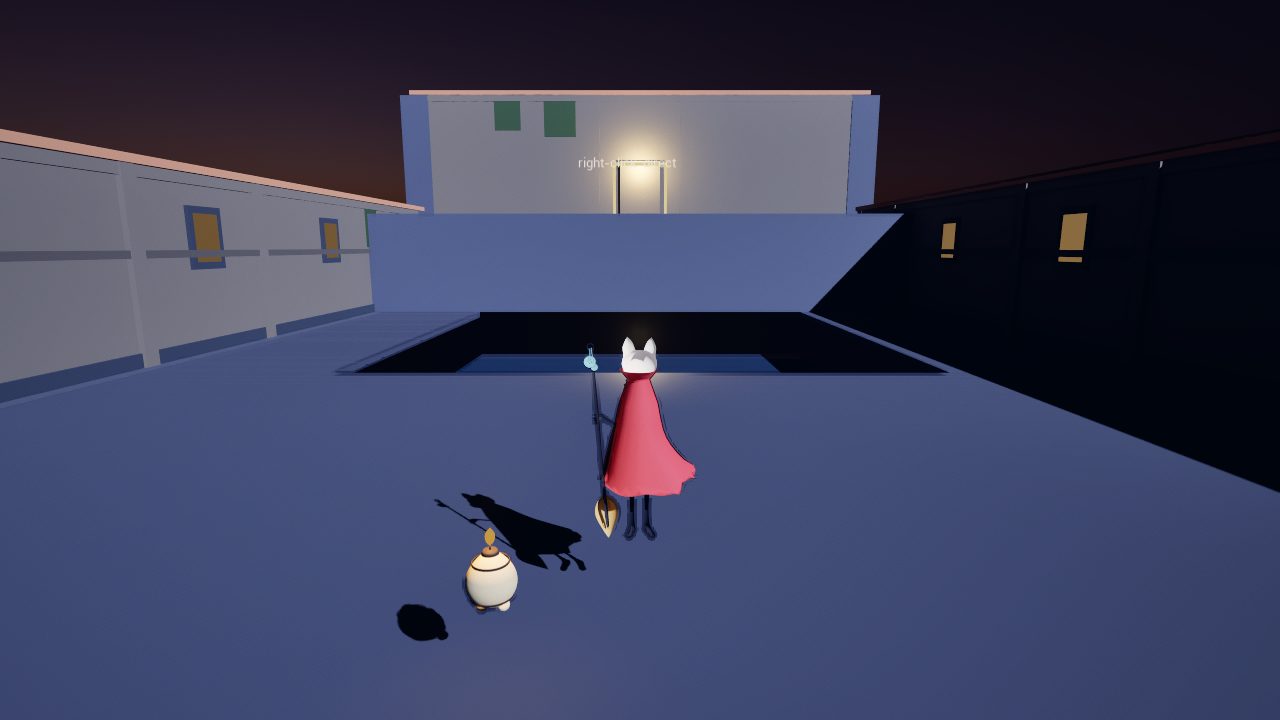
The first dressing pass was mostly invisible at 720p, so the referee required a redo. Items that read wrong were then cut. A water plane looked like a floor that could be dropped onto and was removed. The ivy looked like posters and was removed. The title is now a live dusk shot in which the moth draws its trail across the pond behind the title text. The first end-card camera drifted into a wall and filmed black; this was fixed.
Before dressing. Plain walls and an empty floor.After dressing. Amber windows, string courses and Wick, the small companion.With the flagstone floor.The title on a live dusk shot.
Work
The backlog agent wrote the dressing, floor, sky and card-scene builders and a small drifting camera. The main session added a creature auto-loop and the card-camera hook. The referee judged two dressing rounds. A level checker confirmed nothing touches the puzzles.
Cut
Water plane, borders (invisible) and ivy.
Sat 14 Nov · 22:30 CET
The verb changes: The Shot
The six-room build was played and the mechanics were judged clunky, the puzzles too easy and the game lacking a hook. The verb was replaced the same hour. In The Shot, the player raises a viewfinder, composes a frame and calls Action. Animals in the frame go to what they want that is also in the frame. Cut prints their trail as a walkway. Each scene allows three prints of film.
A prototype ran in one room and was filmed by script: with a wide lens the moth goes to the near lamp, and with a tighter lens it crosses the pond. A bug hunt found that the sky dome had collision and threw the witch 2.5 km out of the room. Puzzle-design research was written, and the old build is kept as the fallback.
The first Shot prototype at 22:12.
Sun 15 Nov
Sun 15 Nov · 09:10 CET
Four scenes, proven overnight
The Shot is now a four-scene game: Two Lamps, Hide and Seek, Let It Go and The Lure. Each was proven by a solver and rechecked in the engine with a scan command or a scripted play-through. Overnight the rooms received a village-kit skin (about 185 non-solid pieces per scene), the animals received reviewed animation, and the game received licensed library music and 59 library sounds. All sounds were chosen by title and converted by script. Packaged at 09:02, title to end card with no errors. The build had not been played in full yet.
Sun 15 Nov · 09:45 CET
A new lead: Fall
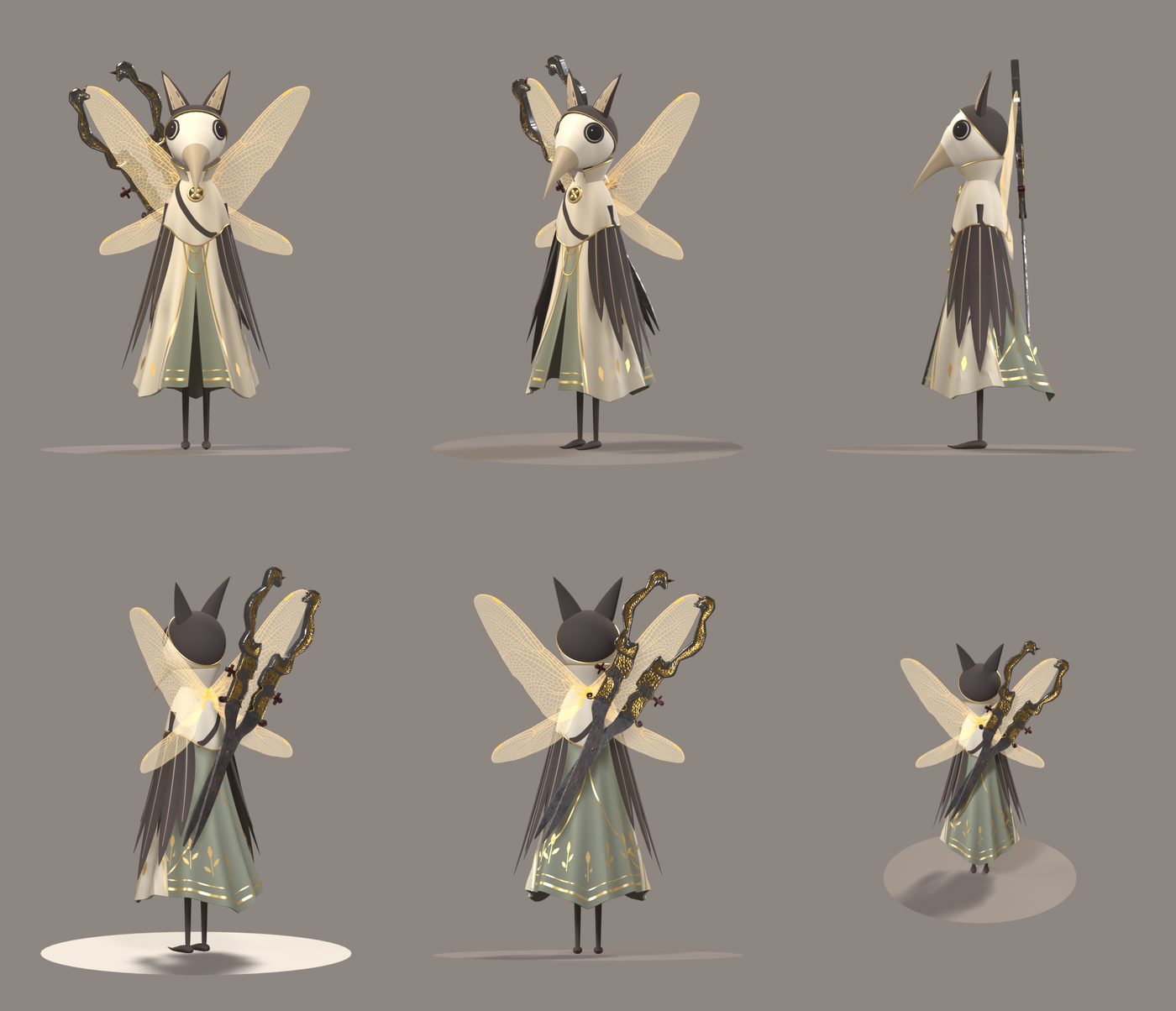
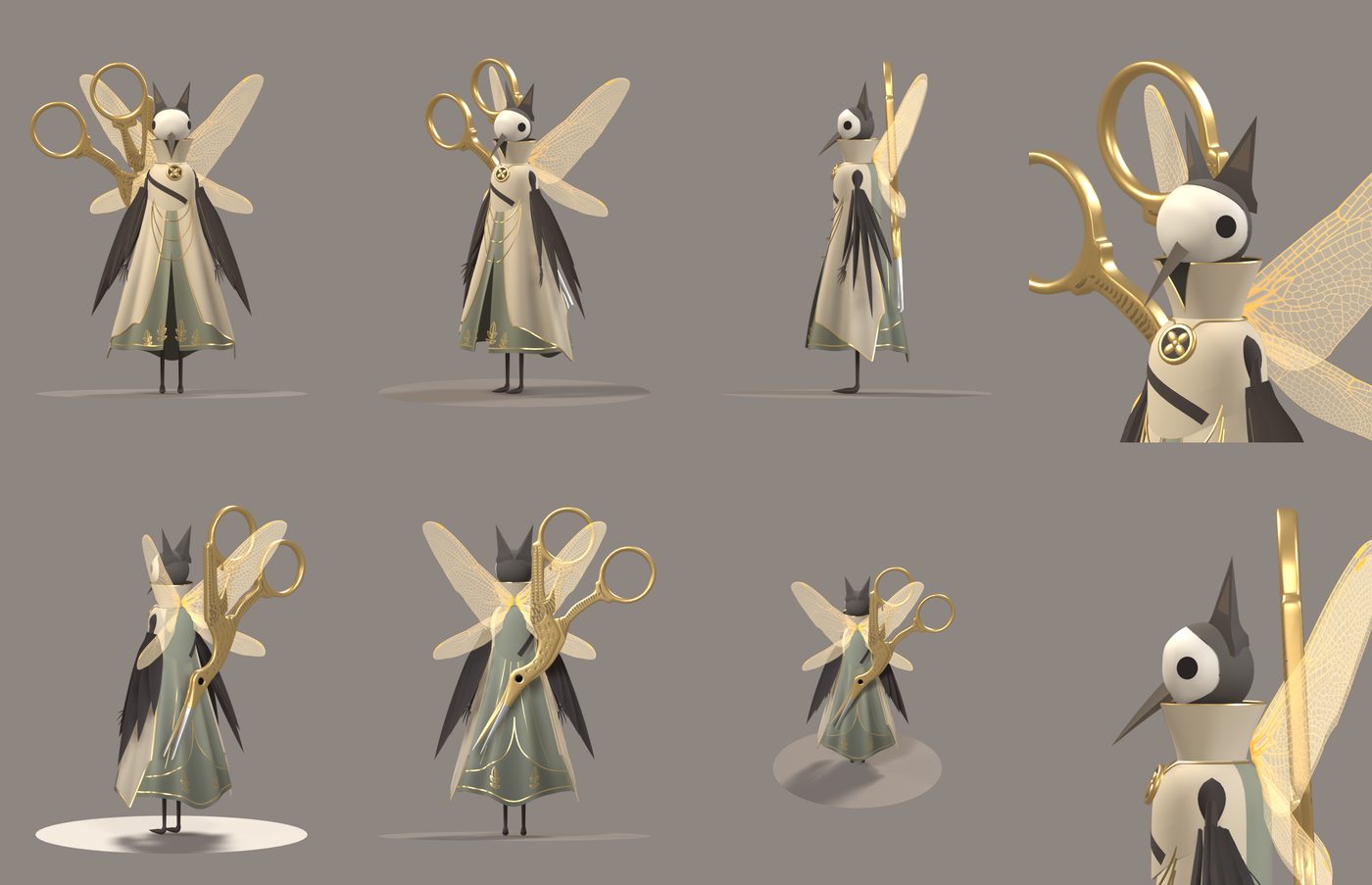
At 09:00 a concept sheet and a pair of free scissors were added. By 09:45 the new lead, Fall, was a 38k-triangle puppet built by one Blender script. It has a bird-skull mask with a drawn eye, a pleated robe simulated as cloth, feather sleeves on springs, dragonfly wings cut from a photograph and lit by a shader, and scissors as tall as the character. The first blockout was sent back as not polished enough. The second is shown.
Fall, second blockout turnaround (09:34).
Sun 15 Nov · 10:45 CET
Fall goes to the referee
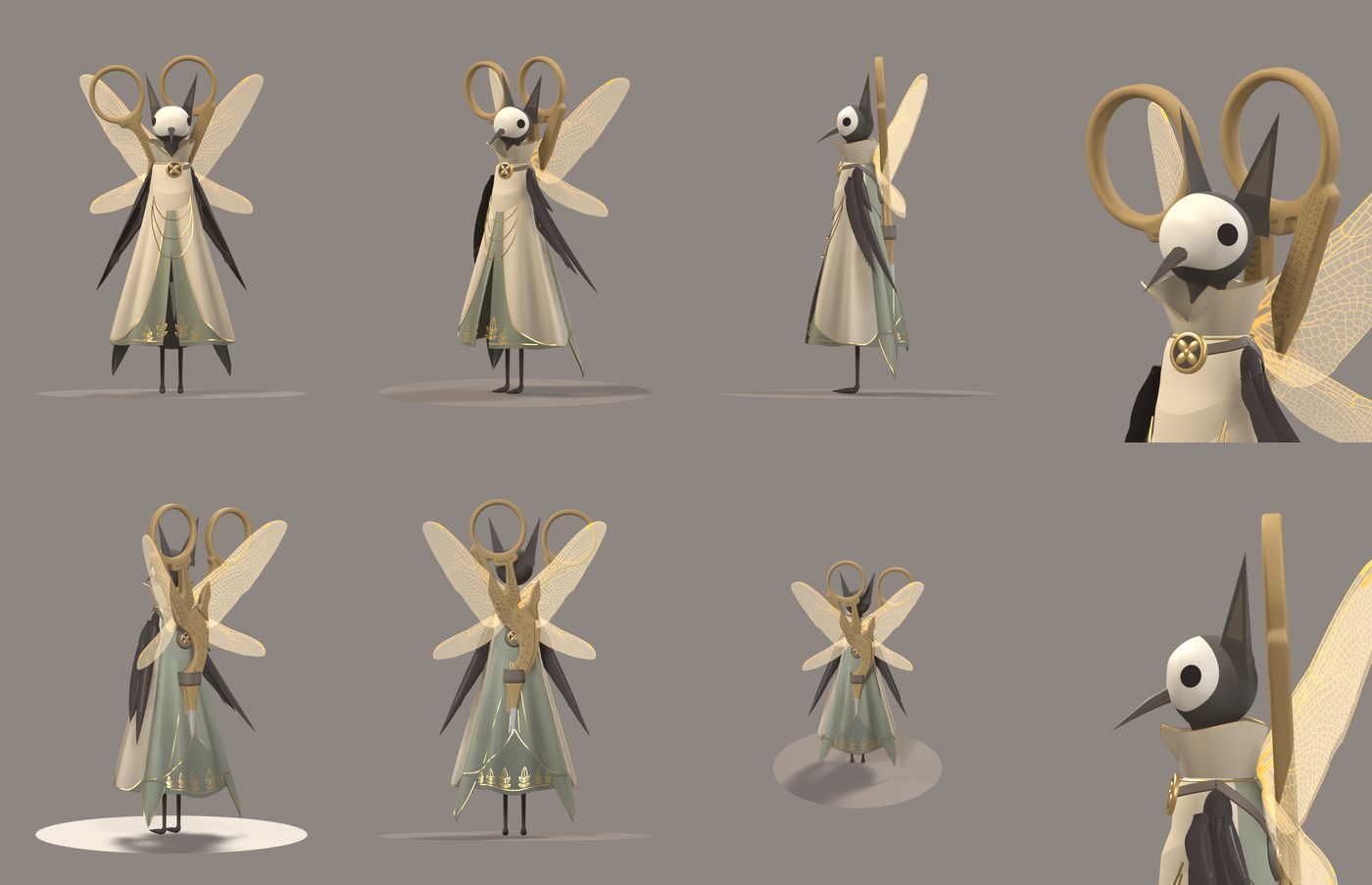
Four fixer agents polished the head, collar, robe and sleeves on private copies of the builder. A referee then compared the result with the concept and returned REWORK: the concept is 8 heads tall and ours was under 6, the capelet should be a long coat, and the feathers read as a skirt rather than arms. The lead fixed the proportions and a second wave fixed the rest. The scissors were swapped for a gold stork whose beak is the blades.
Two changes landed in one hour: architecture in place of plain rooms, and a reason to climb. Seven scenes were packaged at 10:57. The two new ones are The Balcony, where the moth's print gives the angle over a wall, and The Dry Dock, where the cat is framed from above or through a gate. Each was proven by the solver and checked in the engine with scripted takes and a framing scan. The scan found two skips the proof had missed: a tilted frame that let the moth bypass the island in scene 4, and a terrace a running jump could reach in scene 5. Both scenes were re-laid.
The story was rewritten: Fall fell from the bell tower and climbs home on the animals' trails. Every scene now has the tower in its background, nearer each time, and the target is nine scenes ending at the belfry. Twelve agent sessions had been competing for one Unreal process; a lock file and a single builder fixed that. NVIDIA's DLSS plugin was added for anti-aliasing on RTX cards, with a safe-mode start file because the plugin ignores its own off switch unless a hidden setting allows it. That was found by reading its source.
Sun 15 Nov · 11:35 CET
Referees that disagree
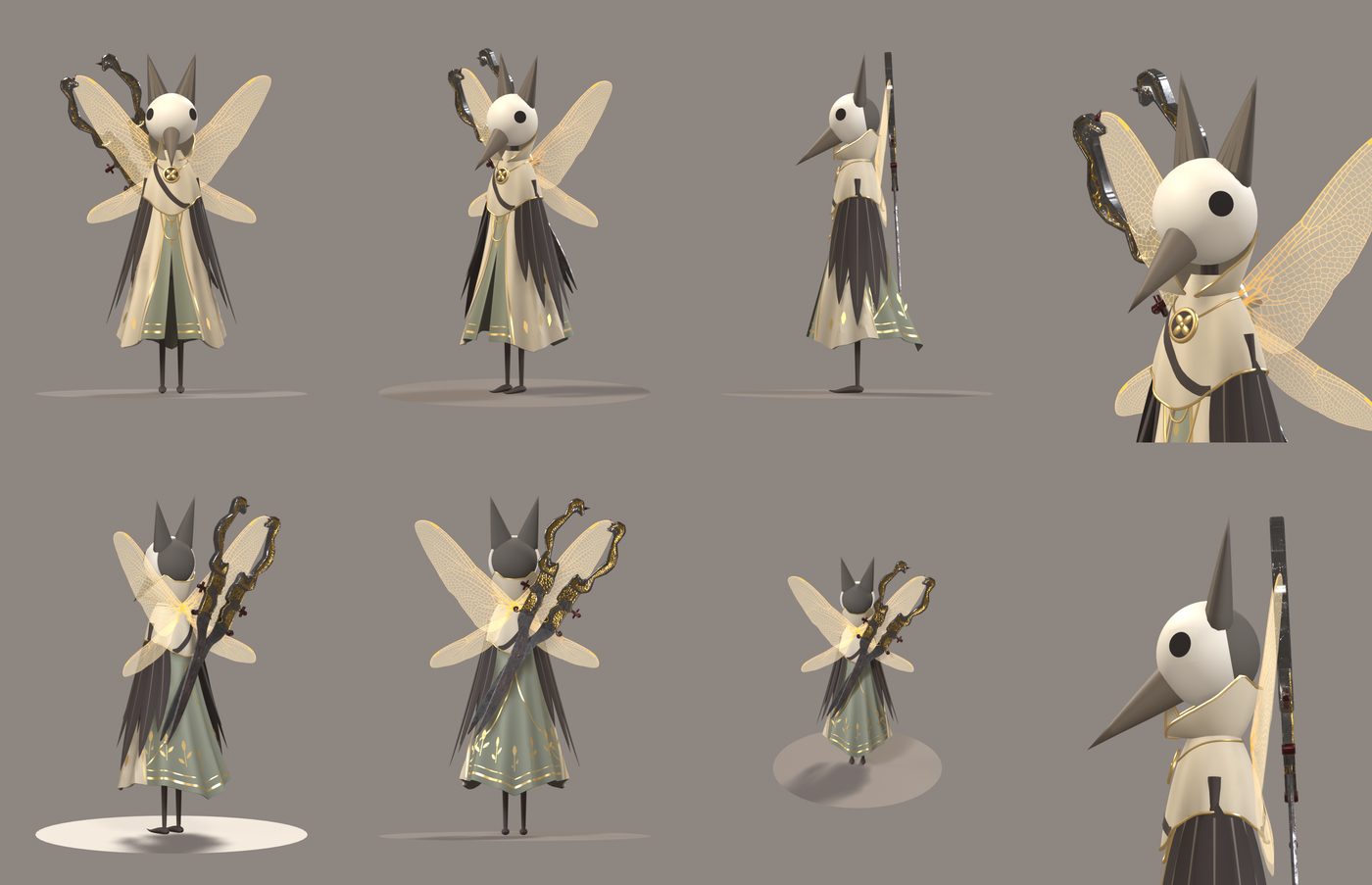
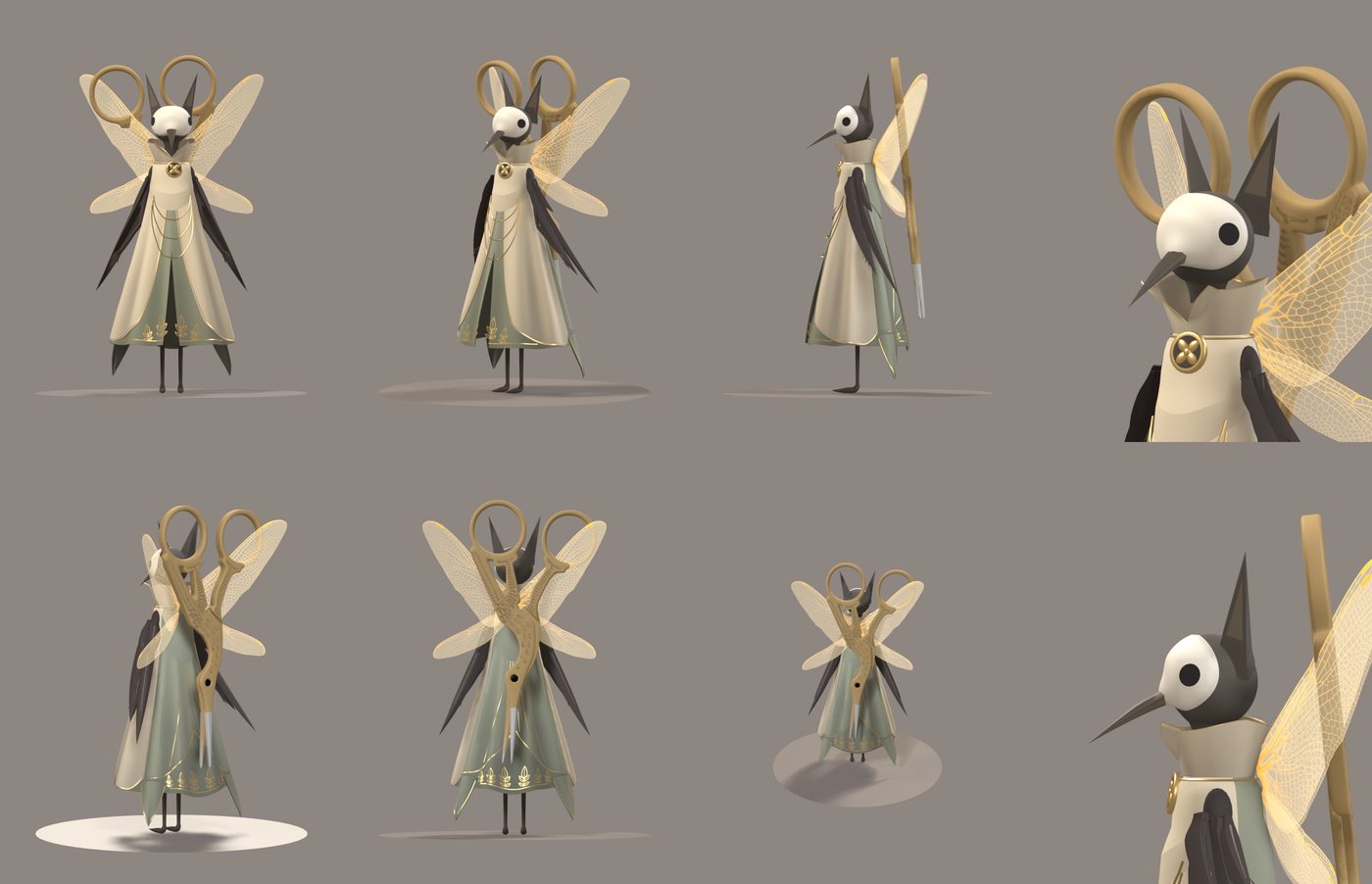
Fall went through four review waves. The referees disagreed with each other (one wanted a funnel collar, the next a pointed one, the third a funnel again) because the concept's own views disagree. The lead wrote down one reading and all later work was built and judged against it. The fourth referee's list was short enough to fix by hand. The scissors now stand upright behind his head. A crude pixel-art render of Fall was made to answer the look question.
A first crude pixel-art render of Fall.Turnaround v8.
Sun 15 Nov · 12:00 CET
Camera restraint
A reference room from a separate Godot realism project showed that what made it feel expensive was restraint, not effects: a 2:1 frame, a 30 mm lens, no handheld wobble and one exposure. FOOTPATHS now uses a permanent 2:1 frame that tightens further when the camera rolls, on a still camera with a lighter vignette and a slight edge fringe (D-092).
Sun 15 Nov · 12:45 CET
Nine rooms become three districts
Feedback on the 12:06 build: the crate idea should ship, and the game should move away from rooms toward order and angle. Nine rooms became three districts on one climb: The Water, The Roofs and The Bell Tower (D-096). The sun rises as the player climbs (D-098). The crate became a core verb, and a new lure (a lantern for the moth, a fish basket for the cat) can be carried to a stand so the player decides where a trail ends before filming it (D-097). The lure was written, built into a test map and checked by script within the hour.
The check script was also changed. It no longer prints lines for an agent to read; it asserts them against the level designer's expectations and exits non-zero. Its first catch was the main session itself, which had blamed a failed take on flight range when the log said frame margin. At 13:10: scene 8 PASS, lure PASS, scene 9 FAIL by 0.11 cm on one over-strict pattern, which stays a fail until the script says otherwise.
Sun 15 Nov · 13:10 CET
No strap: the scissors float
Three ways to carry the scissors were compared and a fourth was chosen: no strap. The scissors float behind him and lag slightly when he moves. The harness that two fixer waves had built (boss, straps, holster band) is now one flag set to False. The stork hovers a hand's width behind his back, upright, and the movement session is adding a soft spring so it trails him. Not in a build yet.
Turnaround v11 with the floating scissors.
Sun 15 Nov · 13:35 CET
A puzzle gate that says no
The session manager built a puzzle gate from its research: a level must have an insight, a tempting wrong move, a forced order and no way to strand the player. It ran over the nine scenes and all nine failed. Scenes 1 to 7 have one to three real decisions each, which confirms the feedback that they were too quick and shallow. Scene 8 hid a soft-lock: taking the film back after crossing the print stranded Fall on the far roof. The fix went into the rules: Z now also returns Fall to her mark, so no take-back can strand her in any district.
Twenty minutes later the level designer delivered The Roofs, the first district to clear the gate: a crate as a step, a terrace that is the only place to see both the cat and its fish, and a cat's walk that becomes a bridge and then a stair. It arrived an hour and a half early. The sound library had no bell, so the bell tower received one made of arithmetic: ten sine pairs at a church bell's partials, minor third included. It has not been heard yet.
Sun 15 Nov · 13:45 CET
Wick gets a hat
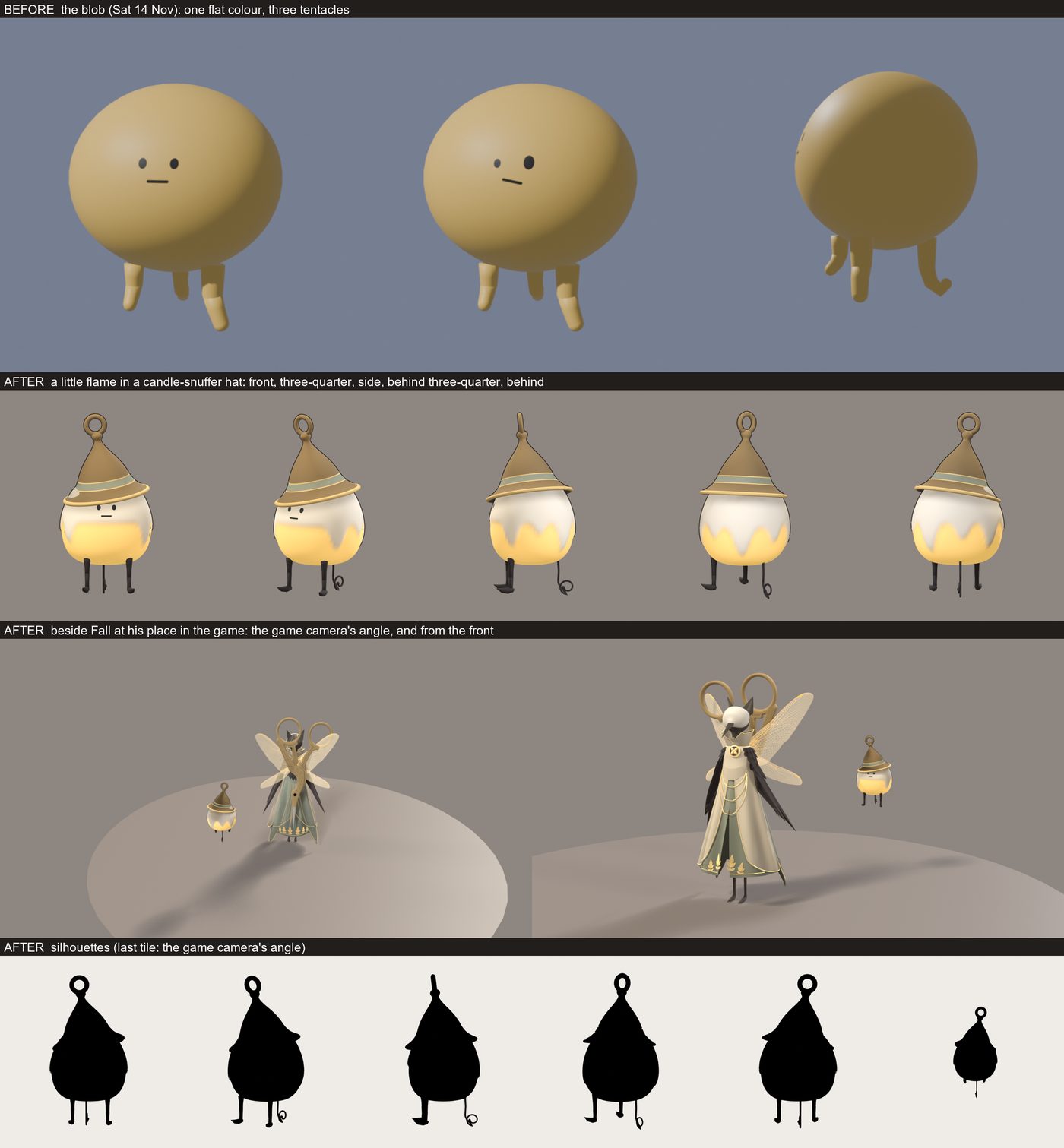
The companion was redesigned to match Fall's world. The orange blob became a small wax flame wearing a candle snuffer: a bronze bell with a gold bead rim, an olive band and a ring on top that echoes the floating scissors. It sits low enough that two ink eyes peek from under it. Pale wax runs down in tongues over an amber core, two stick legs in pointed slippers dangle, and a charred wick thread curls behind. The game code did not change: it already painted any slot called Face with the face material, so the whole body became one Face slot and the paint moved into vertex colours. Blender previews only so far.
Wick before and after (Blender previews).
Sun 15 Nov · 13:50 CET
Fall gets a reason
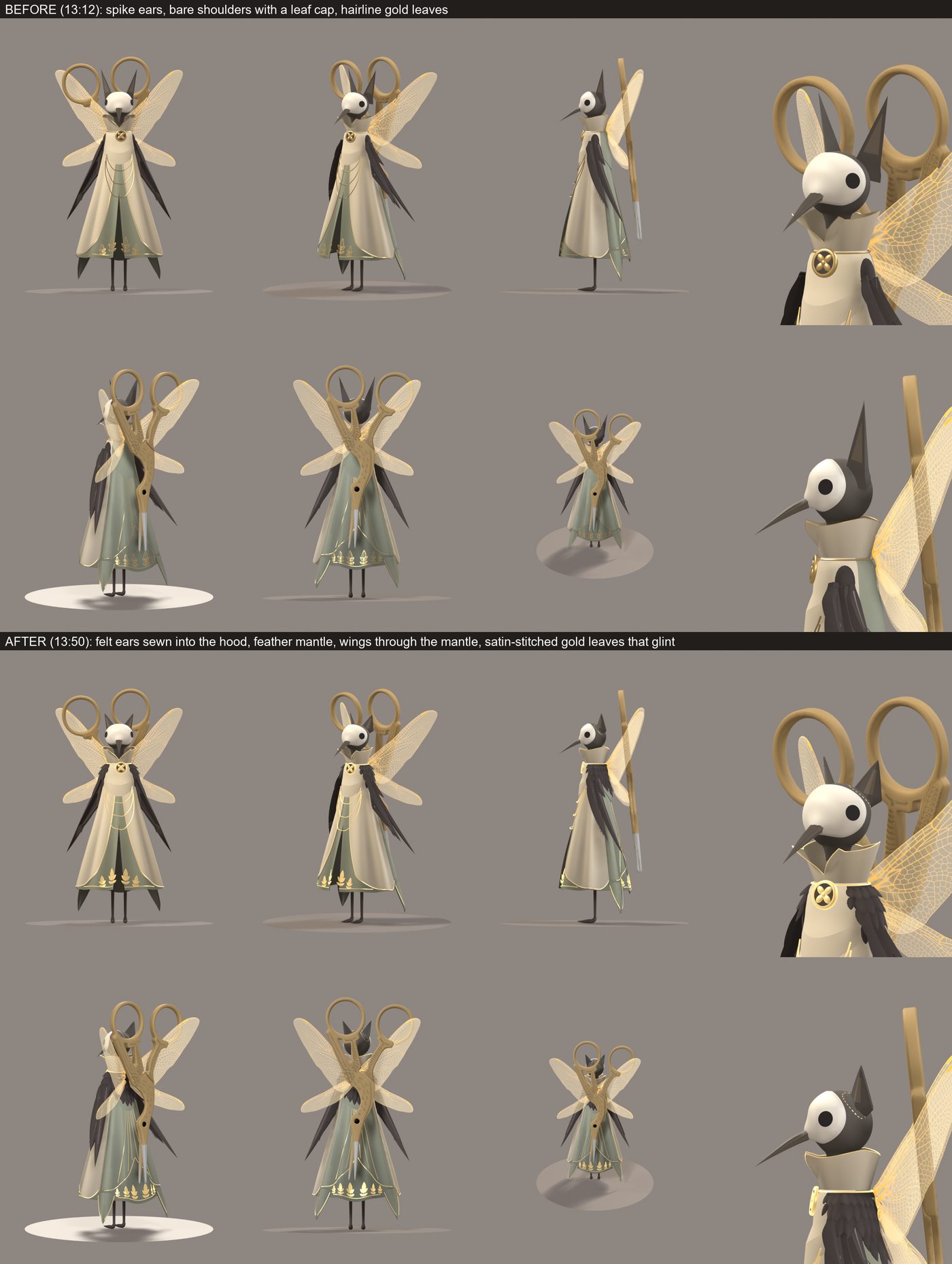
Fall's design was given an internal logic. The trails are threads, so he is a tailor who made his own clothes, and his gold is thread that glints like the trails. His white face is a mask on a felt cowl, so his ears are felt triangles sewn into it. He dresses as a bird because his dragonfly wings cannot lift him, so the feathers are a mantle tied on in rows, with eyelets for the real wings. The new shoulders were approved.
Fall before and after, v12.
Sun 15 Nov · 13:50 CET
Pixel shader previewed outside Unreal
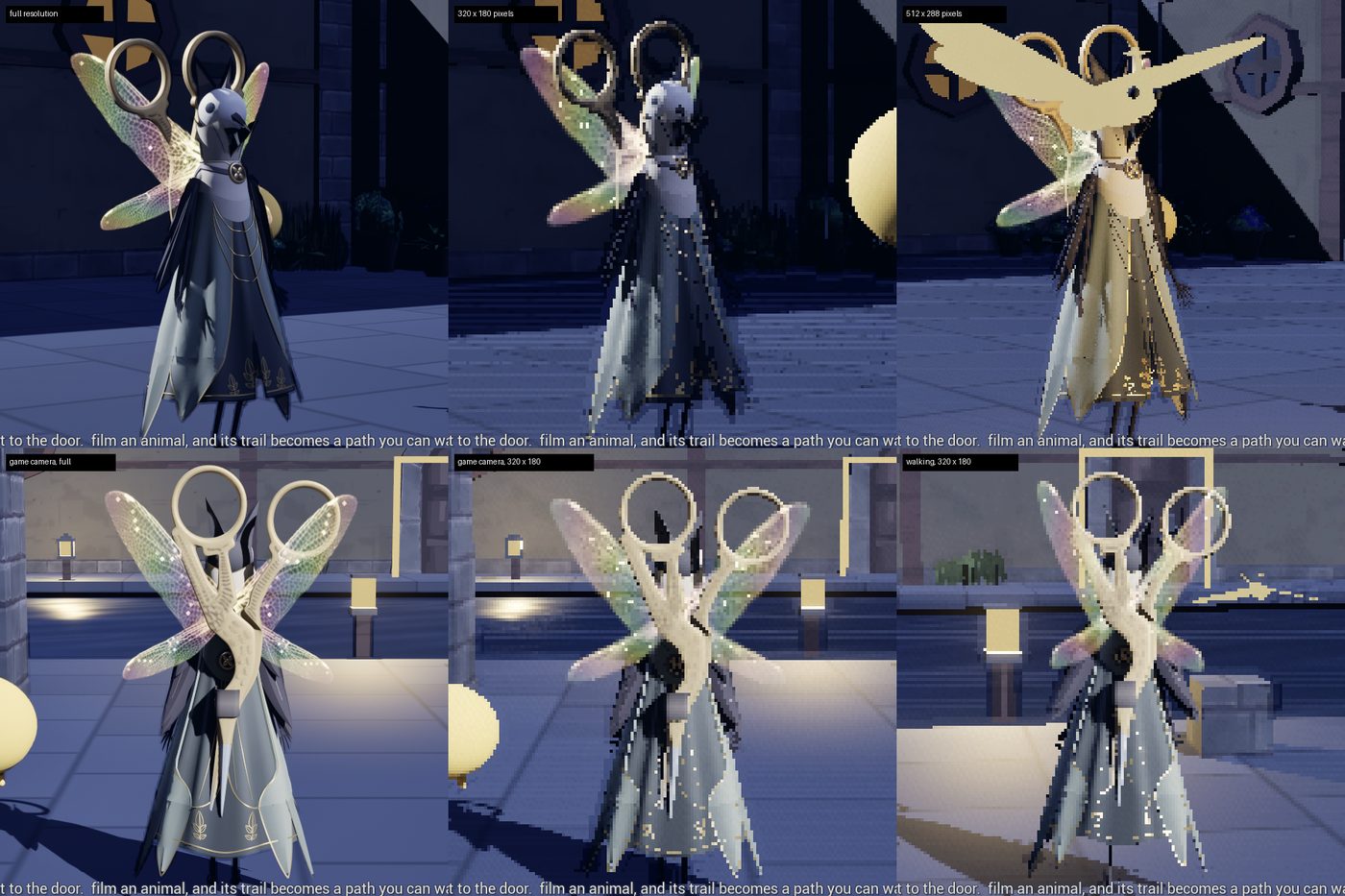
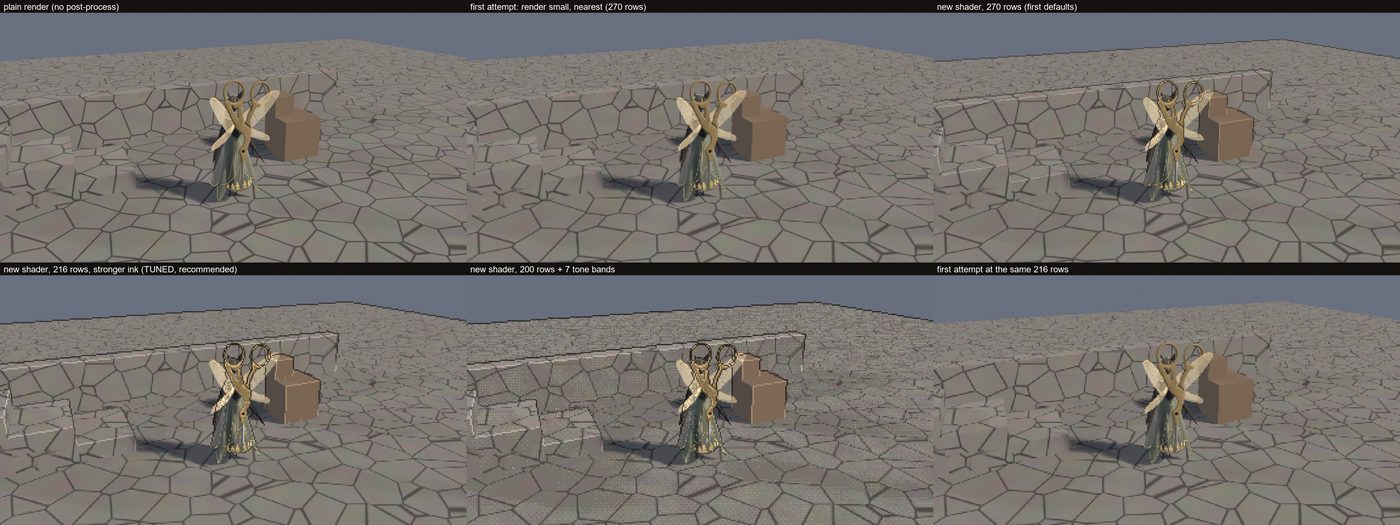
The pixel-art shader was previewed without waiting for Unreal. The material's HLSL was ported line for line to numpy (Tools/pixel_preview.py) and run on pass renders of Fall on a small stone stage from the game camera (Tools/pixel_preview_scene.py). Two fixes came out of it before the shader compiled. The grid anchor is now projected without the TAA jitter (ViewToClipNoAA), and the game can hold the anchor itself (UseAnchor, Anchor), moving it only by whole art pixels so the grid never jumps. Settings: 216 rows (whole 5-pixel art pixels at 1080p), a firmer ink and edge light, bands off. Not compiled in UE yet.
The pixel shader ported to numpy, run on a Blender render of Fall.
Sun 15 Nov · 13:55 CET
Wick becomes a flame
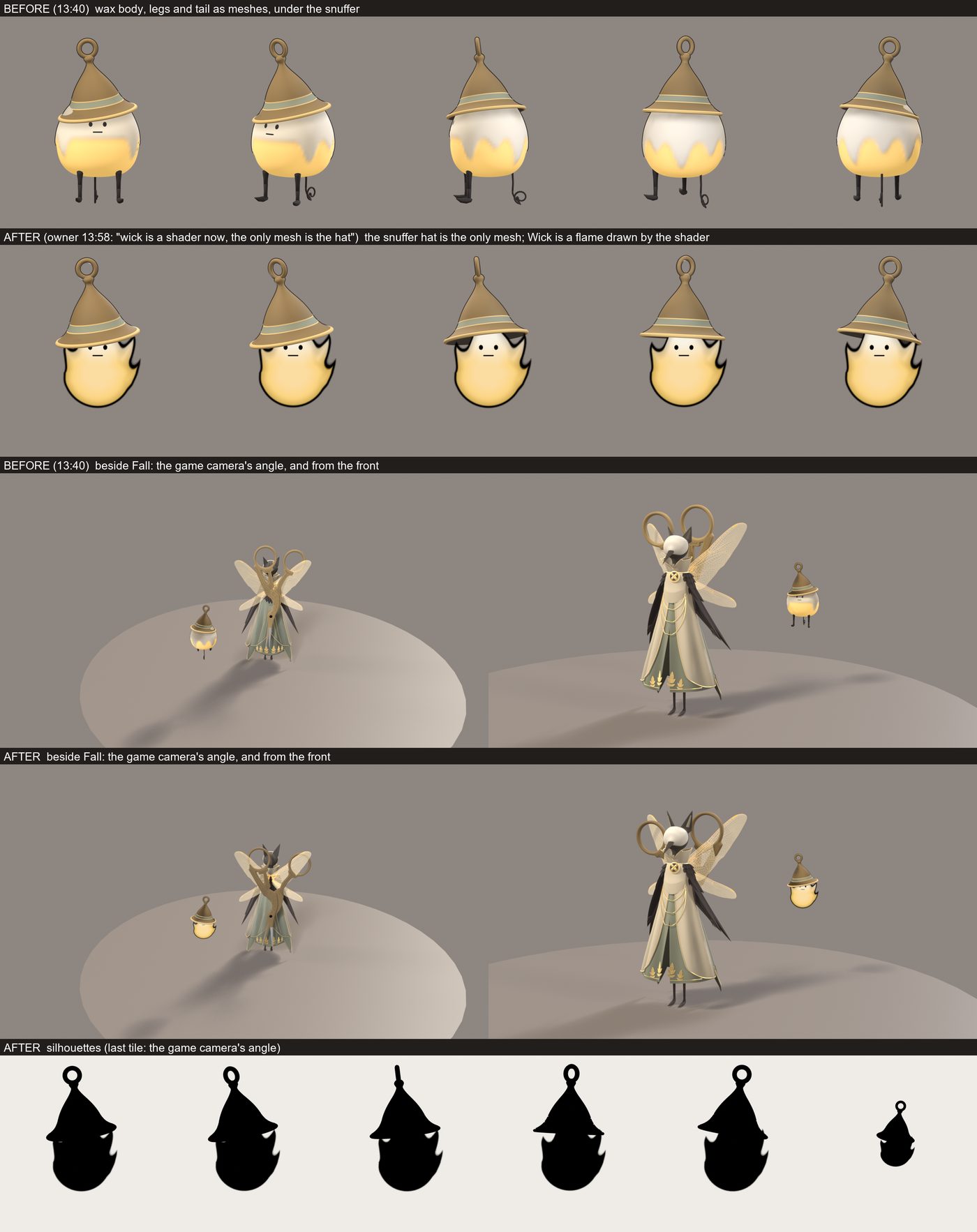
Wick is now a flame drawn by the shader, and the only mesh is the hat. The flame is a round-bottomed teardrop whose point burns up inside the snuffer, with a wavering edge, three uneven licks curling out from under the rim, warm amber below, cream under the brim, an ink rim like Fall's, and ten expressive faces living in the fire. It sits on a card that turns to face the camera. The same few numbers drive the Blender preview and the game shader. No engine frame yet.
Wick as a shader flame under the hat.
Sun 15 Nov · 14:05 CET
Pixel flicker, measured
The tuned pixel look was selected and flicker was given a number. Tools/pixel_flicker.py counts pixels that change between frames of a held camera, and pixels that crawl during a pan. The cause is that depth and normals under the ink come from the jittered frame, while colour has already been resolved by TSR or DLSS. The fix is a Stable switch: art-pixel colour averaged over its area, depth and normals read where this frame drew them (shifted by TemporalAAJitter), and soft edge ramps. Offline, a held camera went from 4.1 % of pixels changing to 1.6 %, and a pan from 3.4 % to 2.0 %. Area-averaged depth flickered more and was dropped. What remains is ink dots along long edges. A night A/B film is ready for the next Unreal slot. Off by default; not compiled yet.
Sun 15 Nov · 14:05 CET
The hat becomes a bucket
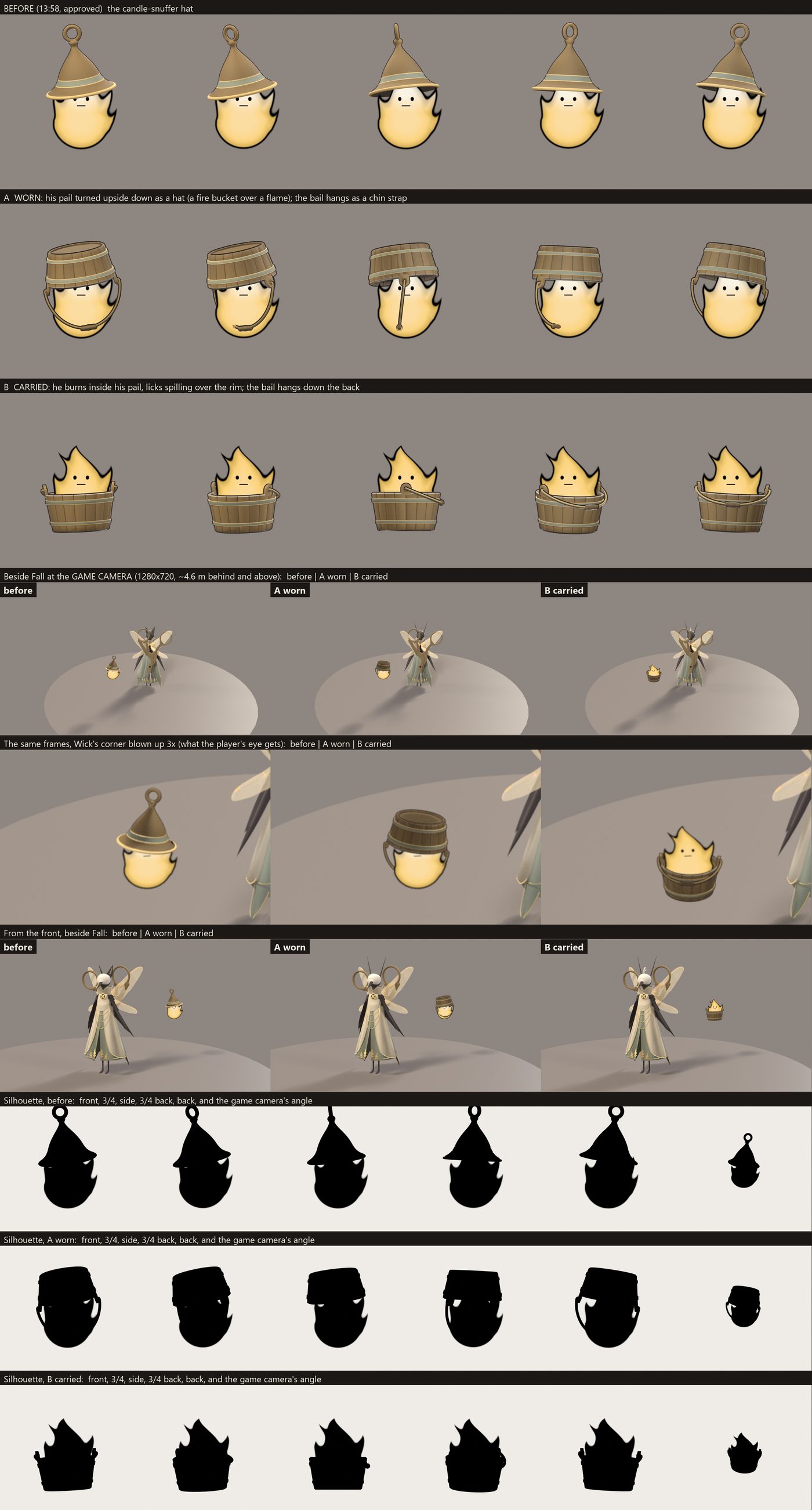
Wick traded the candle snuffer for a small wooden pail: bronze staves with fine grooves, olive hoops edged in gold thread, and two ear staves with holes carrying a wire bail and a bone grip. Two readings were built and compared. Upside down as a hat with the bail as a chin strap, it is funny up close but reads as an egg under a tub at the game camera. With the flame burning inside the pail and licks spilling over the rim, it reads as a clean shape even at 40 pixels. The second was exported. Blender only so far.
Two readings of Wick's bucket, side by side.
Sun 15 Nov · 14:25 CET
A fallen star in a bucket
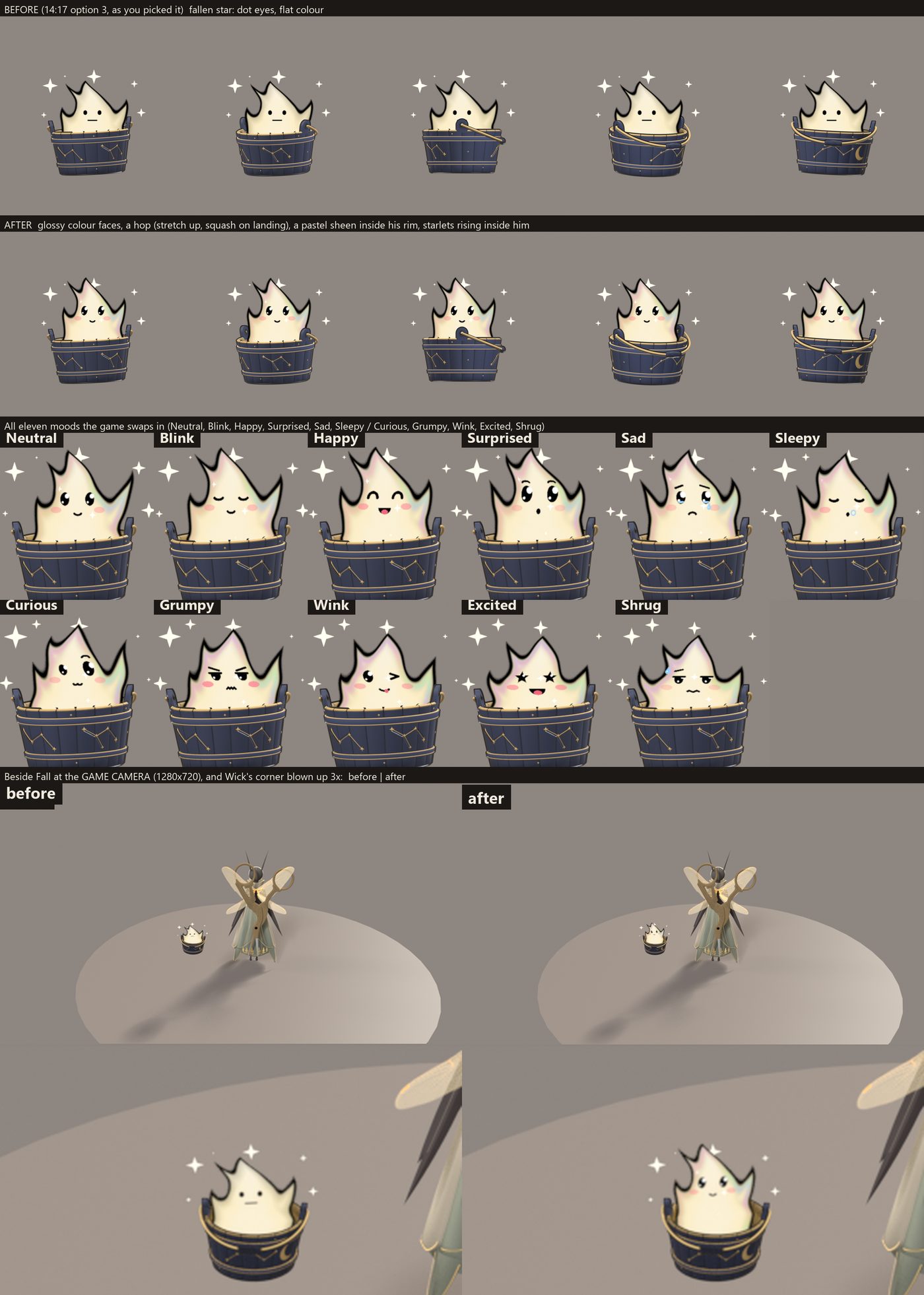
Wick was made more astral. Of three options (moonlit pewter, night lacquer with gold-thread constellations, a fallen star) the star was chosen. His eleven faces were redrawn in colour with glossy eyes and catchlights, rosy cheeks, a tongue for the wink, a tear for sad and a sleepy z. He now hops: every few seconds he springs out of his pail, stretches tall and lands with a squash. A pastel sheen shimmers inside his outline, tiny stars rise inside him and sparks twinkle around him. Every number drives both the Blender preview and the game shader. The shader compiles outside Unreal and has not yet been compiled inside it.
Wick as a fallen star, expressive faces.
Sun 15 Nov · 14:41 CET
Wick gets quieter
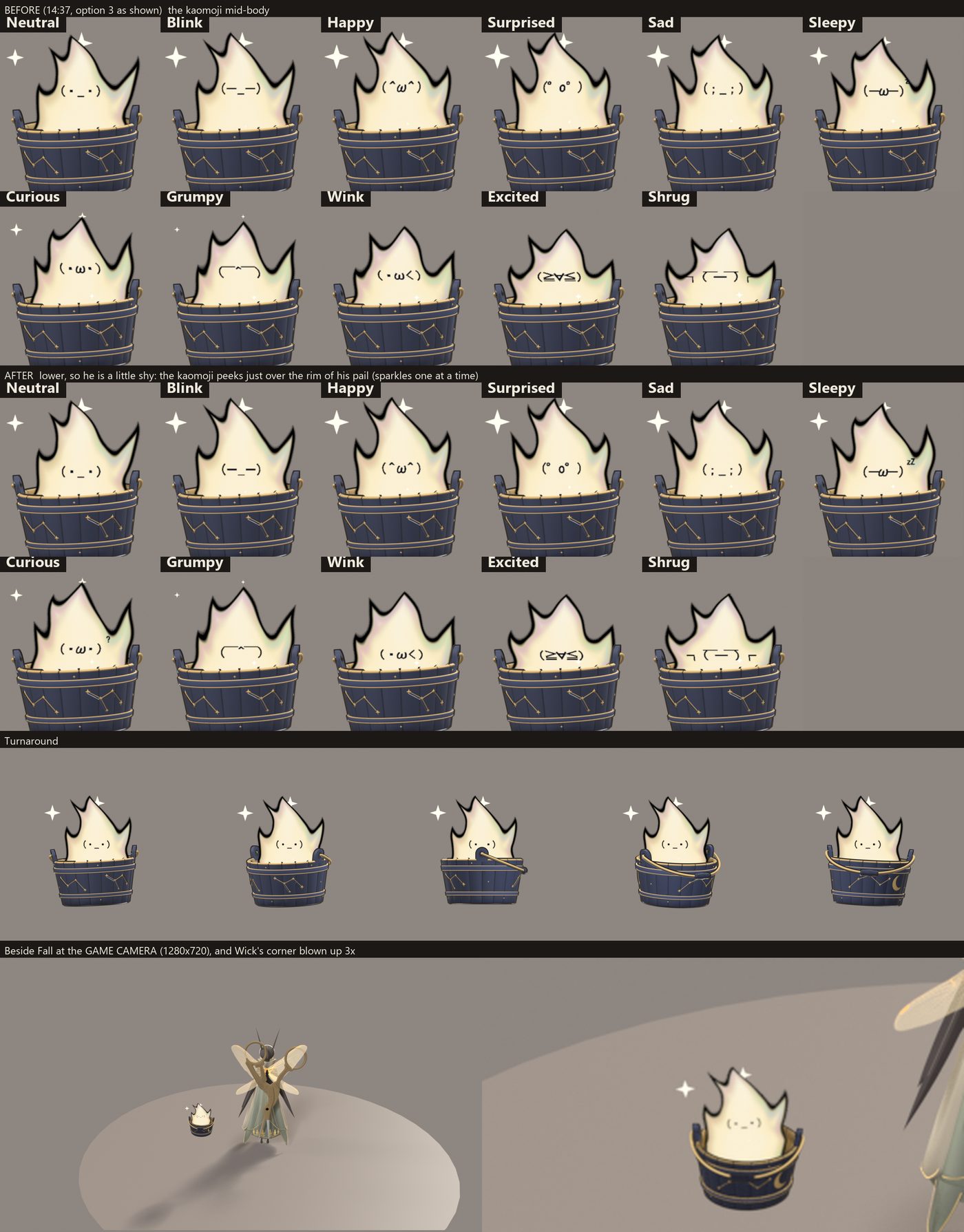
The glossy eyes read as too common and the sparkle as too busy, so ASCII faces were tried. Three face sets were compared: quiet ink marks, a small window of night with two points of light, and kaomoji. The kaomoji were chosen and moved lower so Wick looks a little shy. The face (・_・) now peeks just over the rim of his star-stitched pail. Sparkles come one at a time: each grows, twinkles once and disappears.
The kaomoji face over the rim of the pail.
Sun 15 Nov · 14:45 CET
Three districts in ninety minutes
By 14:42 The Water, The Roofs and The Bell Tower were the game's whole list. Each was proven twice: by a solver that tries three kinds of player and refuses soft-locks, and by a script that plays the solution in the engine and reads the log. The engine run caught a problem immediately. The Water failed its first take because the designer's test aim left a bait lamp one degree inside the frame's edge, and the moth flew to it. The level was fine, since the engine's own scan found 25 working framings. The aim was imprecise, and the brief now says that what is left out must be clearly out.
Decisions of the hour: crates can be pulled as well as pushed, flying stays out until it has been played, readout B (no hints while framing), looks A and C. Mantle, jump and flutter each went in only with a referee's numbers. At the 14:38 freeze a new session had dropped an untested subsystem into the source tree; it was moved back out before the package compiled.
Sun 15 Nov · 15:30 CET
The pixel flicker had one cause
Every frame the camera shifts the picture by a fraction of a pixel, which is how TSR and DLSS smooth edges. The shader drew outlines from that shifting depth, so dots along every edge switched on and off. Holding every input still except one showed that outlines flickered only when depth moved, and three attempts to read a jittered frame more cleverly were measured and none were better. The fix goes upstream: while the pixel look is on, the camera keeps still.
In Unreal, at night, visible flicker on still pixels fell from 0.53 % of the screen per frame to 0.005 %. Moving shots still step, because a flat pixel grid can only lock one distance. An independent referee agreed on the cause and asked for one more capture with the exact shipping setup. Re-shot at 16:20 under TSR with jitter switched off in code: 0.50 % before, 0.010 % after. It became the default, and on the packaged 17:31 build the still screen changes 0.005 % per frame, the same as the game without the shader.
Sun 15 Nov · 16:11 CET
Checkpoint build
Packaged at 16:03 and placed in Builds\Windows at 16:11. It has three districts with the extended Bell Tower. Eight asserting checks pass in the packaged exe (d1, d2, d3x, d2pull, s8z, s8zz, lurez, cratepull), the smoke test is clean, and The Roofs runs at 192 to 200 fps at 1080p. From the playtest of the 14:44 build: paw trails were hidden, cushions appear only on warm sills, and arm swing and follow-through were added. Three scripts would have force-closed a running game after a timeout; they now match their own process by folder. Not fixed: The Water's first picture (camera against Fall's back) and two ways out of the map at district ends.
Sun 15 Nov · 17:12 CET
Sound gets a place
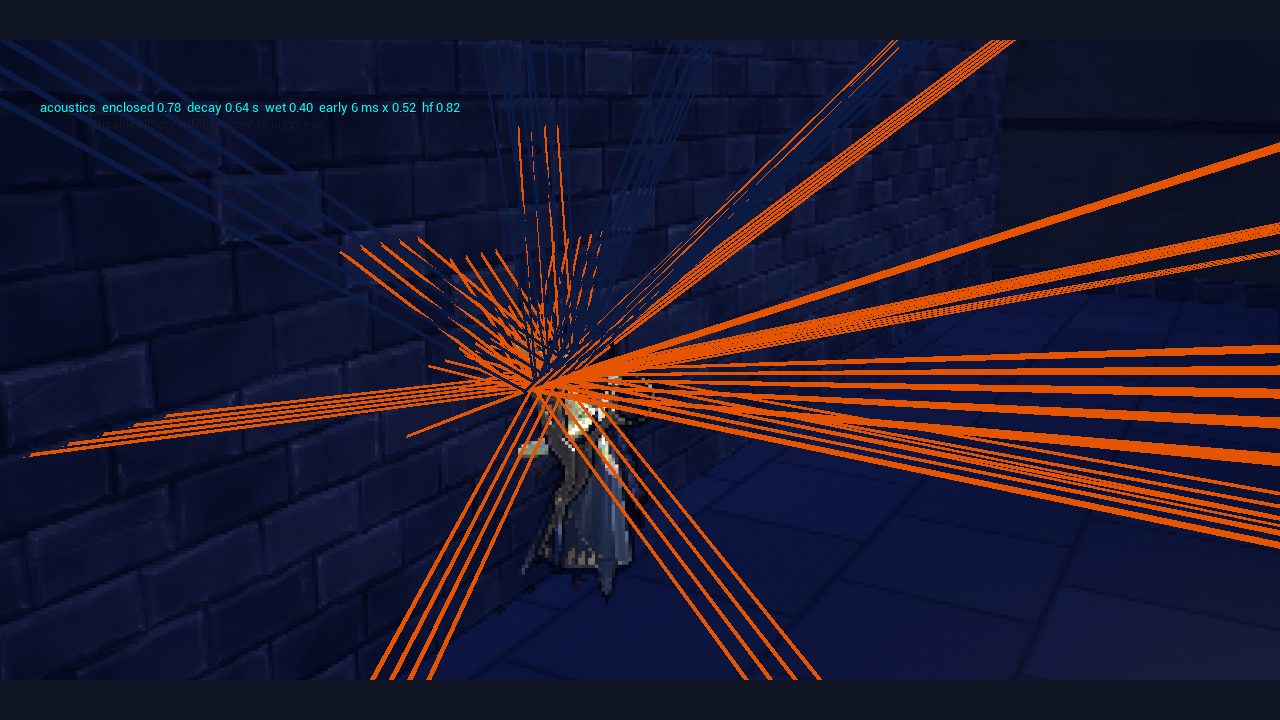
Until now every sound played flat into both ears. A small probe now fires 32 rays from the player's head, 4 per frame, and measures how enclosed she is, how far the walls are and whether there is a roof. It reshapes Unreal's reverb live: a lane rings, an open square stays dry and a far facade throws back a slap. Lamps, crates and animals sit where they are and go dull behind houses. It ships switched off (fp.Acoustics 1 turns it on) until it has been heard. Every sound was also run through two VST chains, "Lantern Tape" and "Glass Night", loudness-matched so the mix holds, for selection by ear. An independent review found that the cat's purr had never been audible because a fader was stuck at zero. Fixed (D-152).
Sun 15 Nov · 17:39 CET
Safe candidate packaged; three items cut
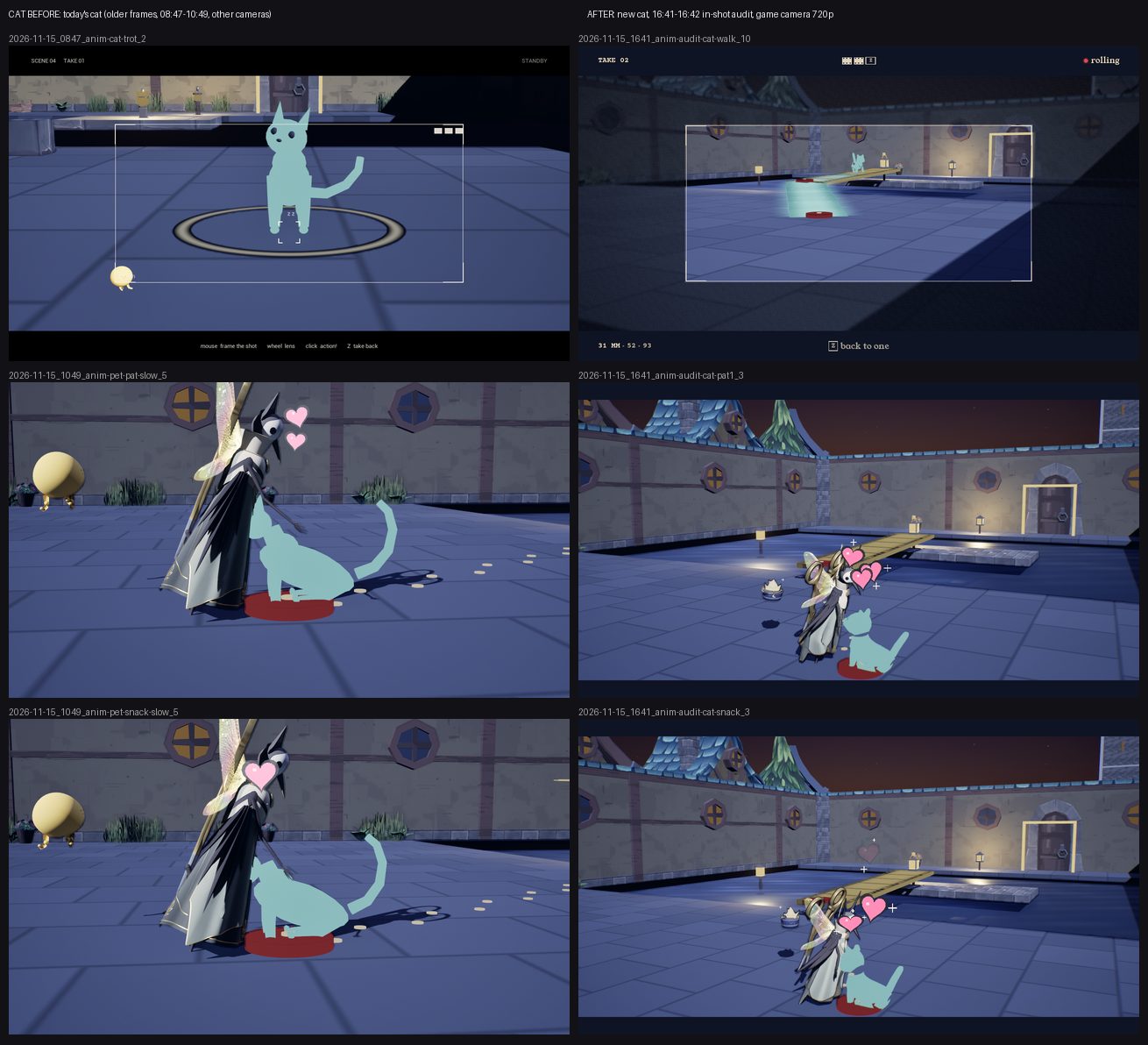
The 17:30 candidate was packaged and swapped in at 17:39. Every packaged check passes, including hold-E pull and crate pull, at 170 to 180 frames per second on The Roofs at 1080p. It includes the hold-E pull, the pixel look with jitter off, the first readout, walls built as buildings, signs of life, half-size brick, normal maps and a new cat credited in CREDITS.md. The cat's roads and starts are fixed.
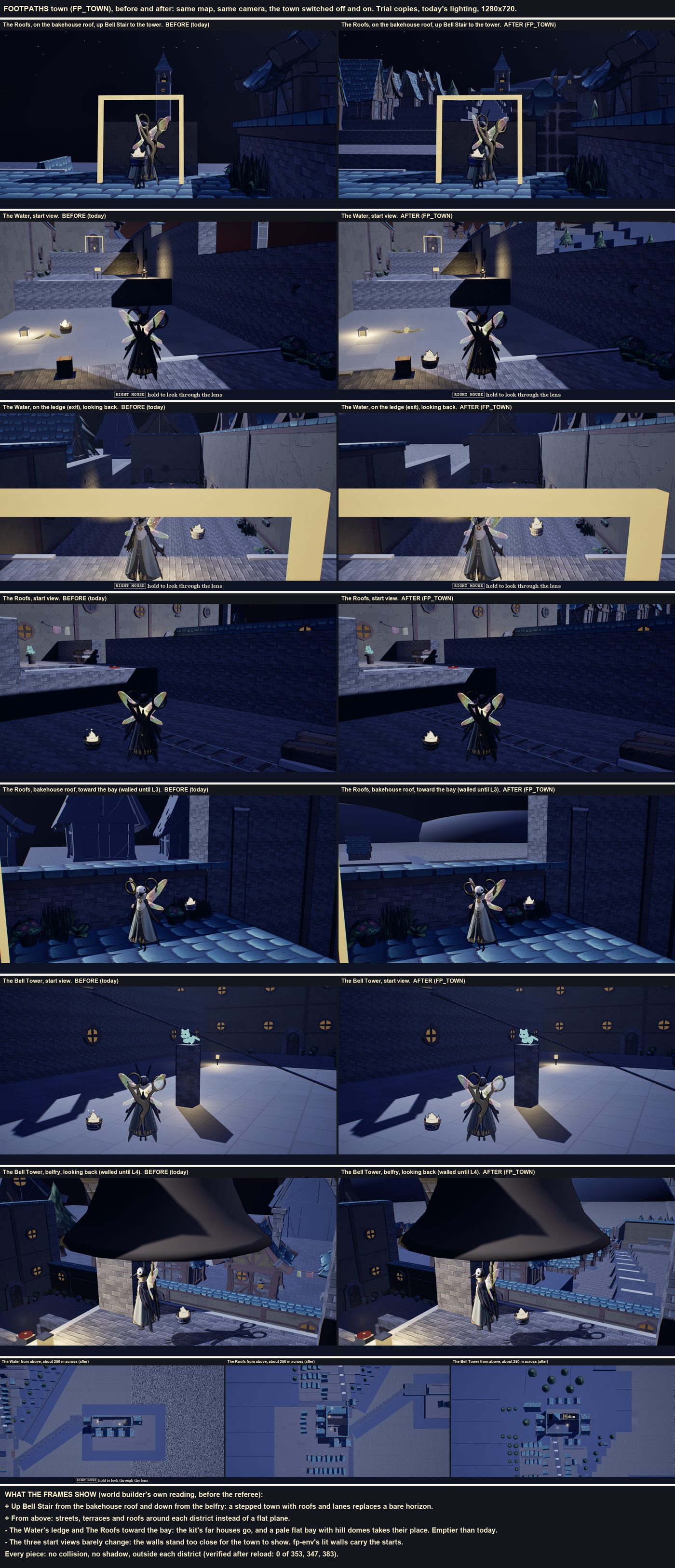
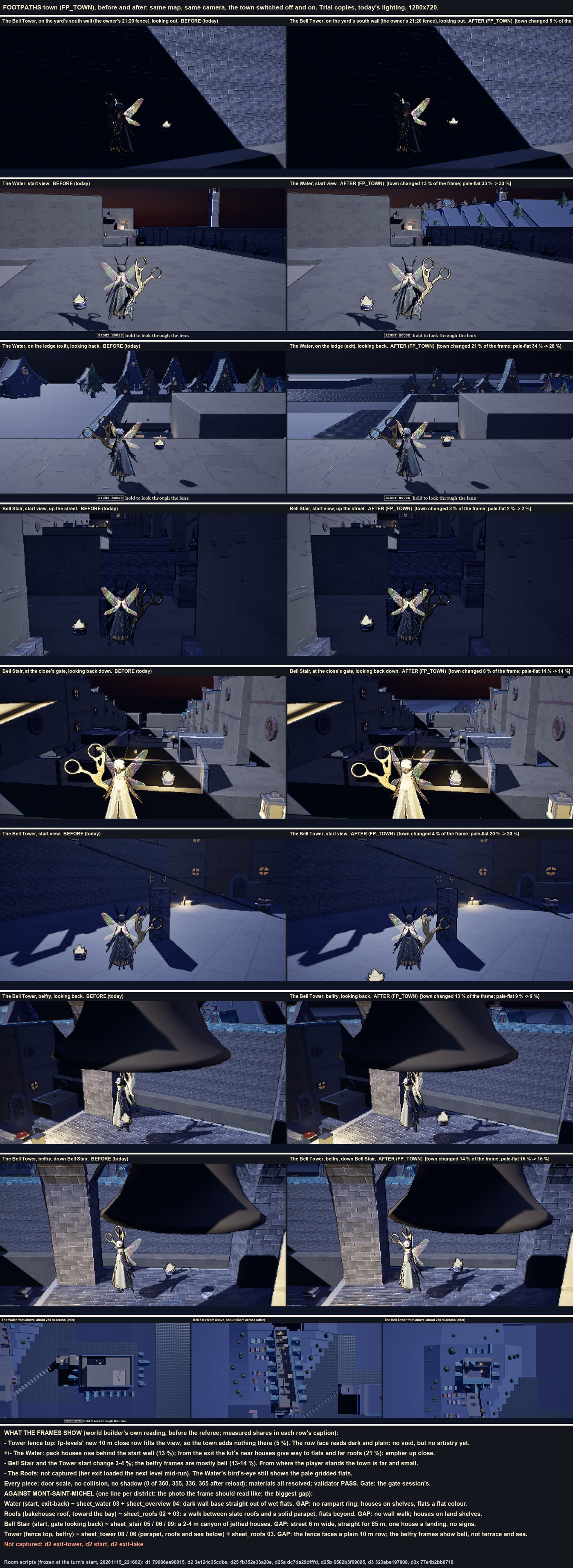
Three items are out. The new water failed because of a builder bug: every rebuild added a second output node. For this reason material proofs now run on the real renderer. The lighting pass failed its pilot because the dawn came out flatter. The town was turned off and will be rebuilt from the village pack.
The cat. Before: the old cat. After: the new cat walking, being petted and eating a snack.The town trial, before and after on the same camera. A pilot only; out of the build.
Work
The main session packaged the build. The manager wrote the checks and the cut list. The world builder ran the town trial.
Cut
The new water (builder bug), the lighting pass (flatter dawn) and the town. Next build: the Glass Night style, seven synthesized sounds replaced with CC0 recordings, and the three silent loops turned on.
Sun 15 Nov · 18:06 CET
One voice for the whole game
Glass Night was chosen by ear. Every sound and the four music tracks now go through one chain of plugins (Raum shimmer, OTT, Ozone Imager), loudness-matched so nothing jumps. The last seven synthesized sounds (scrub tick, magnet, clear, dissolve, arrival, both bells) are now CC0 recordings, cut to the same length and onset so gameplay timing holds. The spatial probe ran in the engine for the first time: beside a stone wall it measures 78 % enclosed and sets a 0.64 s room. An attempt to record the off and on A/B came out empty because the offline audio renderer outran the game, so the comparison has to be heard live. D-154, D-155.
The spatial probe in the engine: 78 % enclosed beside a stone wall.
Sun 15 Nov · 18:30 to 21:00 CET
Four districts, each redesigned
At 18:31 the climb became four districts: The Water, The Roofs, a new Bell Stair and The Bell Tower (D-162). Every district was then redesigned, The Water first, with a hard cut-off at 21:30 (D-163). Each redesign produced two blockouts and one was chosen. The Water became blockout B's islet with A's carried lantern and a hop across lily pads (D-172). The Roofs became B, "The fish you carry" (D-173).
At 20:30 the districts were played and found too monotone, too small and too fast. Every district was restructured into three beats: a platforming leg, the puzzle, and a second leg that uses what the puzzle made (D-174). Ladders were added for this and are switched off until a referee passes the feel (D-175). The exit is now a real door with light behind it and a door sound with a long hall tail (D-159). The pixel look got a pause-menu switch, and the DLSS credit now states that DLSS only works with the pixel look off (D-168).
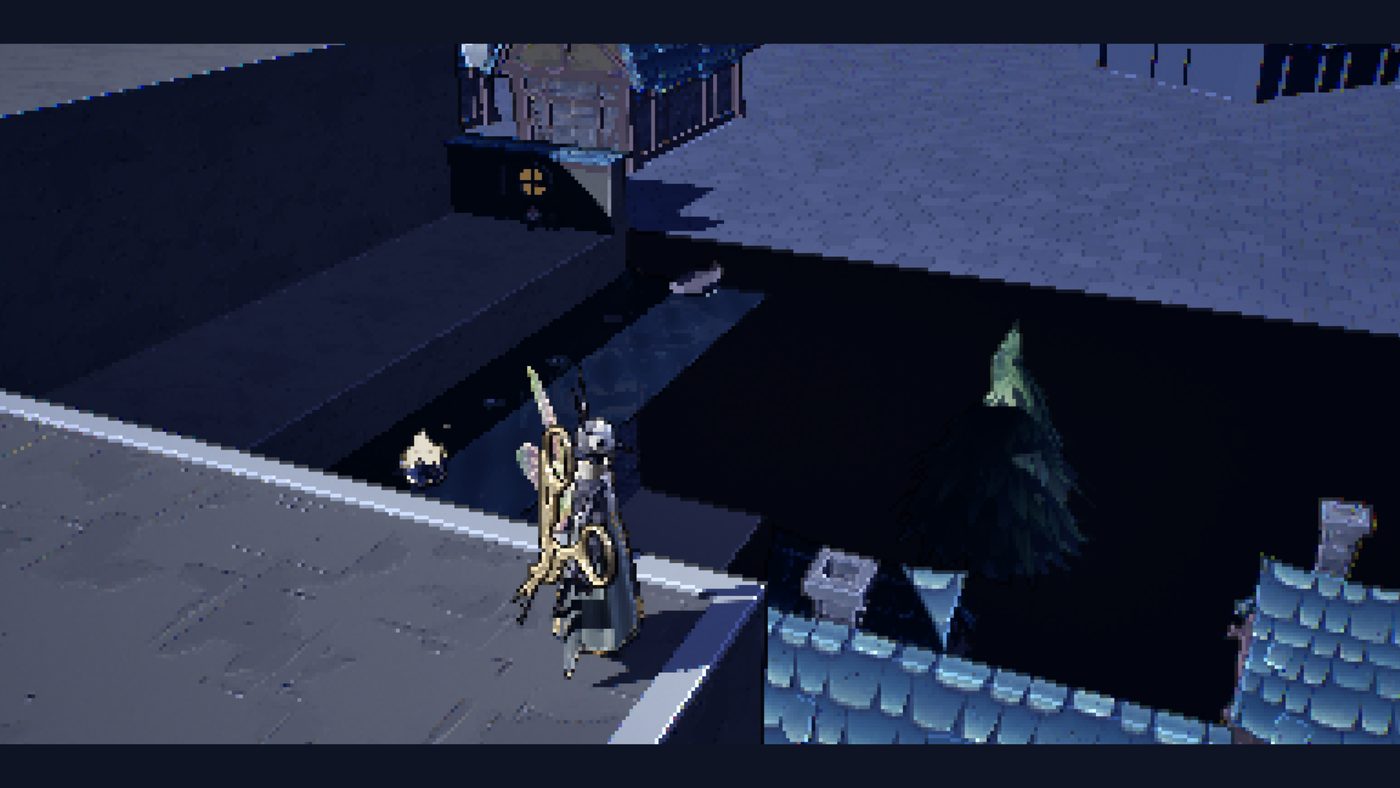
The new exit in the packaged build: the door swings and the light comes out.Bell Stair, the new district, in an engine check at 22:37.
Work
A level designer drew the blockouts. A gate session proved each with a solver (weak, nominal and strong players, ladders on and off). Referees judged the climbs. The UI session built the door.
Cut
The light-paths look for the trails (D-156) and the lantern glass (D-178). Climbing down ladders and grabbing them with E, from ladder v1 (D-175).
Sun 15 Nov · 19:01 CET
Build with the 17:39 fixes
Packaged at 18:51 and placed in Builds\Windows at 19:01. Thirteen asserting checks pass in the packaged exe, three of them new: the Z soft-lock replayed step for step (fish take, pick up the emptied basket, Z, and the cat wants the fish again), and the scene chain through the new exit door in all three districts. Included: the exit door, the Single Layer Water (back after its builder was made idempotent and compiled for real), the Bell Tower's dawn light, cat roads out of the walls, the scissors on Fall's shoulder, the squash-spring flicker fix, Glass Night with seven CC0 sounds, and readable end-card credits. Left out: the Roofs' photo sky, which failed the double-build rule twice. The first blockout, Water A, ships behind a shortcut. Water B was pulled after the gate found a leak in its geometry.
Sun 15 Nov · 20:25 CET
Flicker at low frame rates
Fall's squash spring became unstable below about 16 fps, causing a whole-body flicker. It is now stepped in 60 fps slices. The Fall session verified it on a real-time cheer at about 10 fps: frame-to-frame change 1.96 versus 3.01 two frames apart (smooth), where it had been 6.56 versus 1.73 (flipping). Included in the 19:01 package.
Sun 15 Nov · 21:03 CET
Build with the 20:15 bug reports fixed
Packaged at 20:53 and placed in Builds\Windows at 21:03. Eighteen asserting checks pass in the packaged exe. Five are new: a tap of E behind every crate in two districts (push_d2, push_d3x), the hold-E haul on the crate test map (scrategrip), the viewfinder at native resolution (lens100), and Wick's hint table matching each map (wick_d2, wick_d3x).
Fixed: the viewfinder frame shrank because the game rendered below native resolution once the pixel look held DLSS off. A step off the crate's line put a gate post in the backing path and E did nothing, silently; the player now hauls from the crate's line, and a refusal knocks and shakes the prompt (D-177). Sounds now play where they come from (D-176). Also included but switched off pending a decision: ladders, lit animals and the pixel-drawn animal outline. Wick the helper ships on. The Roofs at 1080p runs at 184 to 188 fps with no other game running. A near miss: the window first built two in-progress redesigns that had been saved in place, and its own checks caught it. Drafts now live in Tools/rooms_draft and the build checks room-script hashes.
Sun 15 Nov · 21:15 CET
Playtest of the 21:03 build
The 21:03 build was played and nine problems were recorded. The main one: the environment visuals are poor, repetitive and unclear in purpose, and read as clunky and soulless. The others: a door that opens onto a wall, a lamp post in an empty plaza with no reason, a fence that can be jumped to reveal an empty world, a bell that cannot be read against its wall, and a Home card that does not use the pixel look.
The working rule for the list: if a level will not make the final build, do not fix it, and record the mistake instead. Shared systems were fixed, and the old levels produced seven lessons. Every door is in a building. Every light has a reason. Every reachable vantage sees a finished world. A place is something specific. One bug was real: straight deck pieces float 17 to 33 cm above the roof at bends, which breaks print collision. The proper fix is after the jam.
Playtest screenshot for note 5: repetitive environment.
Work
The session manager routed each note to the responsible session. A movement probe measured the floating deck.
Cut
Splitting print decks at roof bends, after the jam. The old Water and old Roofs, replaced.
Sun 15 Nov · 22:10 CET
First crew reaches its usage limit
The first crew reached 97 % of its weekly usage. It had been told to prepare a full handoff at 99 %, and did so. Twenty-three sessions each wrote their state to a handoff file and the manager wrote the hub view.
The four final levels were locked by hash at 22:15, each with a full gate PASS (D-182). Bell Stair needed three referee REWORKs before its PASS at 21:56. The final build ships as Development with the console closed, because Shipping strips the logs that every packaged check reads (D-180). Known weak spots are recorded: no lower quality tier for weak GPUs, and a possible hitch the first time each bell plays (D-179). The town around the districts stays off while a more efficient approach is decided.
The town sheet at 22:17. From the player's views it changed 3 to 21 % of the frame. Off.
Work
Main compiled and packaged. fp-levels and the gate locked the rooms. Every session wrote a handoff.
Cut
The town (undecided, off). Animal polish and pixel rings, off: the sheet missed the animals after the layouts moved.
Sun 15 Nov · 22:35 CET
Second crew takes over
A second swarm was started with a board and one contract: while the first crew's main session runs the final build window, nothing else touches Unreal, the source or the build scripts. Work is staged, reviewed by someone who did not write it, and then goes into one polish build. If the polish build failed a gate by 00:45, the first crew's final would ship as it was.
The new crew has lanes: SHIP builds, SUBMIT handles the trailer, the store page and this log, UX and ATMOS stage fixes, and QA only reads.
Work
A hub session and five lanes, each starting from a written handoff.
Sun 15 Nov · 23:00 CET
Blind playtest
A second person played the game with no instruction and nine notes were recorded. Items that can be picked up need a visual cue, and so do the places they can go. Rewinding has to put crates and items back or the player can lock themselves out. The zoom needs an introduction without text. Crates need a sound. The cat flies when it should not. The cat's mesh has gaps. The pixel look should be finer. When the player was stuck, Wick should have said something: a clue with a sound and a speech bubble, and after a while a suggestion to rewind.
None of this was on any list. Twenty-eight automated checks passed and a person still got stuck in the first minute. The notes became the scope of the last build (D-191).
Work
The hub split the nine notes across six workers, one owner per file.
Sun 15 Nov · 23:11 CET
Package script stopped twice on false failures
The first crew's final build stalled. The SHIP session found the cause by reading the script. A text replace meant for one word also renamed a check, d2exit_bell, so the script waited for a log that could never exist. Separately, the smoke test's room list did not include Bell Stair. Neither was a game bug. SHIP ran the missing check by hand (PASS), finished the package and swapped it in at 23:11. Results: 28 packaged checks PASS, a walk through every room, a start from a clean folder, the zip identical to the checked build, 0 error lines.
Work
SHIP took the Unreal lock from the first crew's main session at 23:11:03 and finished its build.
Sun 15 Nov · 23:13 CET
Final build rejected
The final build was played and rejected as not release ready. The environments and terrain need a complete overhaul: courtyards in pure black, flat planes with no texture, and houses sunk into a plane up to their roofs.
A worse problem was found in The Water: walking to the exit door kills the player. The last checkpoint sits on a roof 6 m above the door, and the game respawns anyone more than 4 m below their last checkpoint, so the door is a death. All 28 checks passed because none of them walks; they move the player to the door with a debug command. No package now ships without a check that walks down to every exit and touches it.
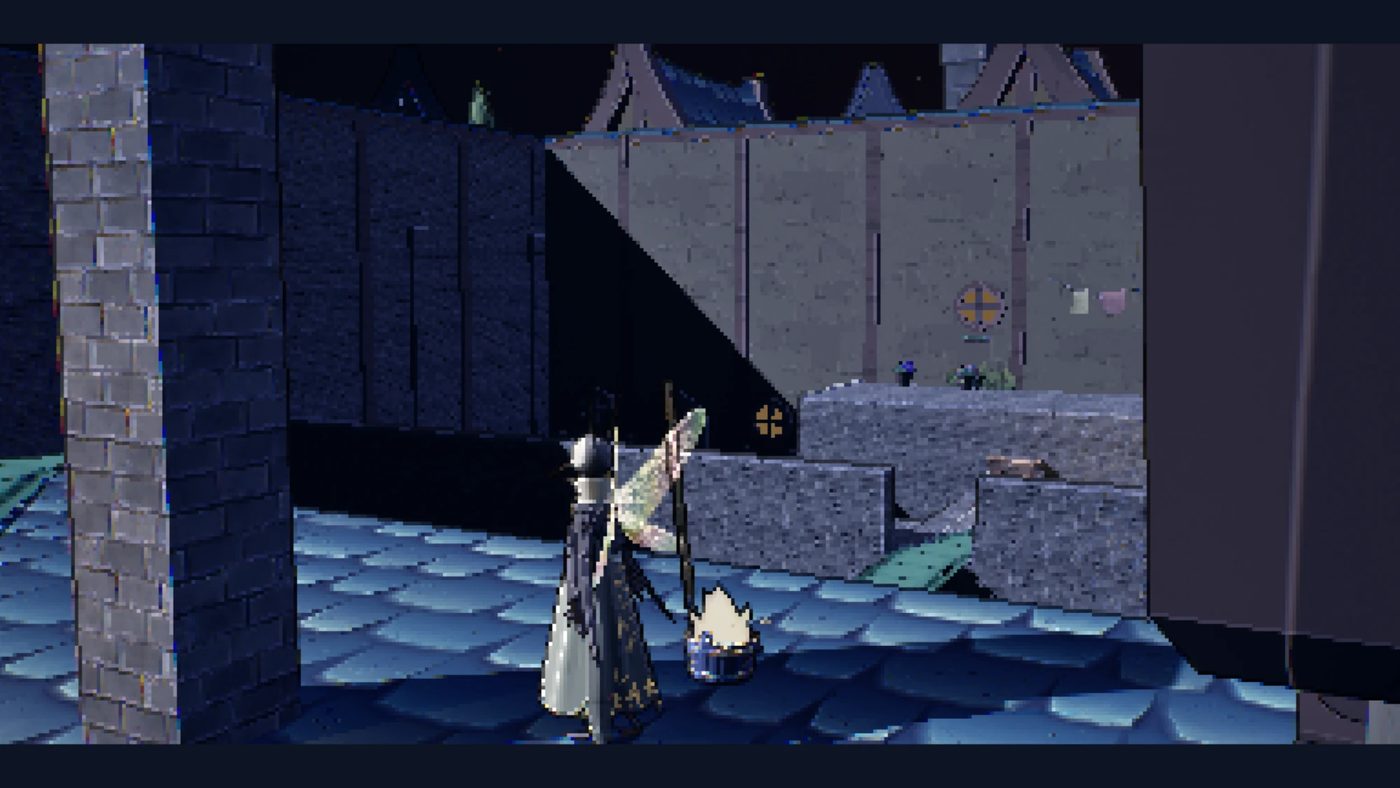
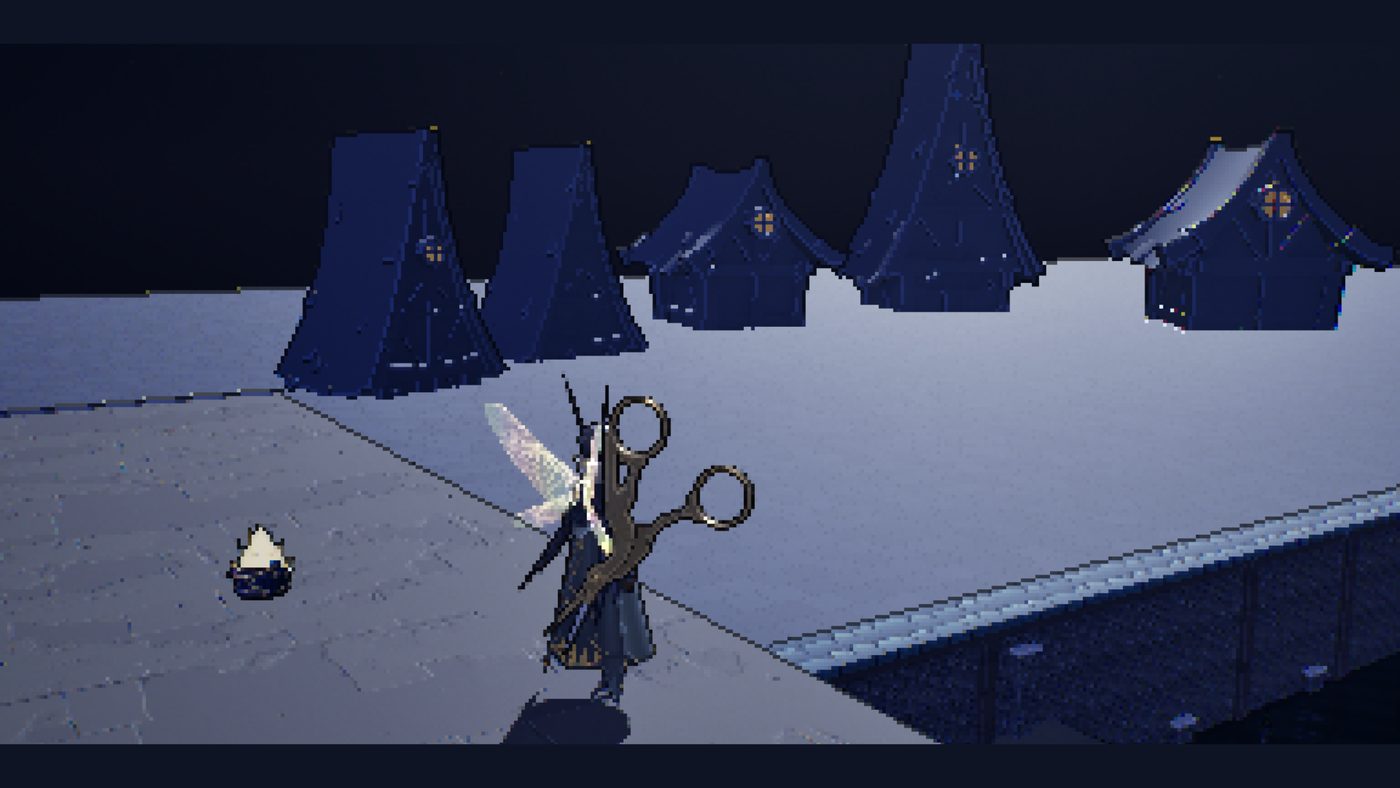
Final build at 23:13: a black courtyard and flat planes.Final build at 23:13: houses sunk into a flat plane.
Work
An agent traced the door death to the respawn rule (more than 400 cm below the respawn point). SHIP added the walked exit probe to the gates.
Cut
The first crew's final build stays on disk as an emergency copy and will not be submitted.
Sun 15 Nov · 23:30 CET
One working copy, one owner per file
Fifteen agents were building one polish build and could not all touch the source. At 23:02 the hub copied the source into a working copy. Each worker edits only its own files there, and every new behaviour has its own switch, on by default. QA reads the diff, and SHIP copies the files into the real source after checking that nothing changed underneath. A set that does not compile after two tries is left out whole.
The environment work followed the same rule. The look team wrote its changes as scripts on top of the locked levels, never inside them. A loop rebuilt the maps and rendered frames from the player's views. Environments were to freeze at 00:40 with the package due at 01:00.
Work
A hub, SHIP as the only Unreal operator, QA reviewing every set, and workers for gameplay, UX, Wick, audio, the cat, atmosphere and the environment.
Sun 15 Nov · 23:54 CET
What shipped
The build for submission is FOOTPATHS_FLOOR2_judges.zip (573 MB), packaged at 23:54. It contains the changes from the last session on the existing four levels: rewind restoring crates and items, pickup and placement cues, the lens introduction, Wick's clues, the crate sound, the cat with its mesh gaps closed, the level-one door fix, engine text turned off and an updated README. The cat's animation in this build is a mid-work snapshot.
Verified on the packaged build: with the door fix switched off, the player respawned on the causeway exactly as reported (centre 467 under the line 600, last rest 1000). With the fix on, the door is reached in all four districts with no fall respawn on the way. A self-playing walk through all six stops ran with no errors, both from the build folder and from the zip extracted into an empty folder. The zip contains no Saved folder and no test launchers, and is under 1 GB.
Not verified: the two designed falls that must still respawn; the feature tests for rewind, lens intro and Wick; the 28 puzzle checks and the frame rate on this build; and the jumps between door checks, which teleport along the route. The build has not been played through. Known issues remain, and the environments are the same ones rejected at 23:13.
Work
SHIP packaged and verified the build.
Cut
The environment overhaul and the 01:00 polish build.
Mon 16 Nov
Mon 16 Nov · 00:00 CET
Environment overhaul: planned, not shipped
A full environment overhaul was specified in docs/briefs/ENV_OVERHAUL.md, covering terrain through level layouts. Its main idea is to build the whole island once (bay, tidal flats, rock, ramparts, village, abbey, bell tower) and place each district inside it at its true position, so each level sees the real neighbouring levels instead of an empty box. The brief is based on Mont-Saint-Michel measurements and a UE 5.8 research pass. It uses meshes for terrain rather than the Landscape tool, plane-based Single Layer Water, and procedural placement for decoration only. An independent review found 14 errors in the first draft, and all were fixed.
A second session started on it at 23:36 and, within the time available, ran a headless Blender generator for the island: 9 FBX files, 8,052 to 12,328 triangles per variant, bay 2,228 to 2,288, far shore 688. These were never loaded in the engine, never rendered and not reviewed. The session paused at 00:30 when the usage limit was reached. Nothing from it is in the submitted build, no Unreal process was started and nothing shipped was touched.
Work
One session wrote the brief and one session started the island generator.
Cut
The whole overhaul, for this entry. It resumes after the jam, starting with a checkpoint of the shipped state.